Se afișează postările cu eticheta Bugatti. Afișați toate postările

sâmbătă, 9 aprilie 2016

Bugatti Type 30 Tourer 1925 - World Of Classic Cars -

Bugatti Type 30 Tourer 1925

The Bugatti Type 35 remains today the most successful racing car, in terms of overall number of victories, ever built. The heritage that led to this all-conquering model began here, with the Type 30, the first eight-cylinder production Bugatti.
The Type 30’s engineering was not as exciting as subsequent Bugattis, nor was it fast; where it excelled was in jewel-like mechanical sophistication. The engine sported a barrel-type crankcase under a pair of fixed-head cylinder blocks, surmounted by a single cambox in which the overhead camshaft operated the valves by finger-type rockers to the two inlets and a single exhaust valve per cylinder. Carburetion was supplied by a pair of either Zenith or Solex carburetors; ignition was initially by magneto, with a coil used for later cars.
Bugatti Type 30 Tourer 1925

A fine four-speed gearbox with right-hand change lever and mesh gears, shifting through a wet multi-plate clutch, ensured the remarkably rapid gear change for which all Bugattis were renowned. The I-beam front axle was new and substantially constructed, and hydraulic front brakes were installed, with the rear drums considerably larger than those at the front.
Almost exactly 600 examples of this thrilling little car were produced between 1922 and early 1926.

CHASSIS NUMBER 4725
Bugatti Type 30 Tourer 1925

Chassis 4725, presented here, is accompanied by a report compiled by Dutch Bugatti expert Kees Jansen. Jansen notes that the car was ordered by Bugatti agent Dubuisson of St. Quintin for his customer, Mr. Chavel, and that the chassis was produced in January of 1926. Dubuisson purchased the rolling chassis only, with an unknown coachbuilder producing the elegant four-passenger open Tourer body, with two doors: one on the left, for the front passenger, and one on the right rear! Importantly, early photographs depict the car with the sexy rakish vee’d windshield that it still wears today, showing that it has had this feature since new. The car was driven on garage plates 1651 WW5 by Bugatti racing driver, Louis Charavel, who competed successfully under the pseudonym of “Sabipa.”
Bugatti Type 30 Tourer 1925

Delivered to Monsieur Chavel, the car remained with his family until 1960, a remarkable 35 years of continuous ownership. It was subsequently sold to J.P. Léger of Dreux. A photograph, published in Yan Verdier’s Y Une Vie pour Bugatti, shows the car in this period at Henri Novo’s famous Bugatti garage, with the engine removed; it was at this point that the current engine, 418, another correct Type 30 unit, was installed. Also in this period, the car was refinished in its present color scheme of yellow with black cycle fenders and wire wheels.
The next known owner was Henri Chambon of Clermont Ferrand, who purchased the car in 1972 and registered it as 7892 QG 63, using it at the International Bugatti Meeting in Denmark five years later. It next passed to Bernard Viallon, a well-known collector whose stable included a number of Bugattis. Viallon’s cars were famously used for color illustrations in one of the most famous works on the Bugatti marque, Bugatti Magnum, written by the renowned Bugatti historian Hugh Conway and published in 1989.
Bugatti Type 30 Tourer 1925

The car has now been a resident of its present owner’s collection for two decades and during that time has seldom been shown in public. It retains its original frame, transmission number 1420 (a high number due to the fact that the same type of transmission was also used on the Brescias), and original rear axle number 588. The finishes throughout are in good condition, including the attractive paintwork of the body, older but overall well-preserved brown leather upholstery, rich inner wood capping along the sides of the body and dashboard, and a black cloth top that is in good shape. Marchal headlamps accentuate the overall sporting appearance, while the underside and engine bay are presentable and correct.

sâmbătă, 26 martie 2016

Bugatti Type 49 Roadster by Gangloff 1928 - World Of Classic Cars -

Bugatti Type 49 Roadster by Gangloff 1928

The last of the early overhead-cam eight-cylinder Bugattis, the Type 49 was described in a contemporary report as a successful blend of comfortable carriage and lively sports car—something that still aptly describes the rare survivors today. A mere 470 examples were built between 1930 and 1934, of which the example offered here, chassis number 49431, is the rare and dashing short-wheelbase variant.
This car was one of two identical examples ordered at the same time by Bugatti agent Antonin Joly et Frères of Tunis, and it was sent to Alsatian coachbuilders Gangloff, that great favorite of the Bugatti factory, for their especially lovely roadster body with a “dickey” seat, folding windshield, and artfully flowing fenders. It is important to note that this very sporty coachwork actually predates the similar design credited to Jean Bugatti for the later Type 55! With body number 393 installed, the car was subsequently delivered by Joly to a client who wished to register it in France.
Bugatti Type 49 Roadster by Gangloff 1928

The history of this Type 49 picks up in 1955 in Paris, where, still very original and intact, it was registered as 579 DW 75. Several years later, the attractive little roadster participated in the 1958 International Bugatti Rally, organized by the Dutch Bugatti Club, which included stops at Château d’Ermenonville, the home of Ettore’s daughter Lydia, as well as Le Mans. It also appeared the same year in a French film, La Chronique Provenciale.
In 1967, the Type 49 came up for sale at Henri Novo’s garage in Montrouge, Paris, and was subsequently sold to Jess Pourret, the well-known collector and historian famous for his works on Ferrari. Monsieur Pourret reported the car to Bugatti historian Hugh Conway as 49431, with engine number 275, in 1974, indicating that it had retained both its original identity and engine up to this point. He participated with the car in a Bugatti rally at Bec Hellouin in 1968 and at a Bugatti Owners Club meeting at Prescott in 1969.
Bugatti Type 49 Roadster by Gangloff 1928

Later, the Bugatti became one of many wonderful automobiles owned by the noted French collector Michel Seydoux, before its eventual sale through well-known broker Edgar Bensoussan.
At some point, the Type 49 gained the serial number tag 49122, however, in studying the Bugatti and its components, there is no question that this is actually 49431. Aside from the replacement of the original carburetor with a Weber unit and the addition of an auxiliary radiator under the chassis, there is no evidence of major changes made to the car during its long history.
Bugatti Type 49 Roadster by Gangloff 1928

The woodwork in the body bears the Gangloff number 393, and the drivetrain appears to be completely matching with engine number 275, transmission number 277, and rear axle number 277. The internal frame number is 1179, which, at a glance, appears to be a late Type 44 number, however, Jansen notes that, by the time of this car’s production in late 1931, the short-wheelbase Type 49 was available only by special order. Rather than manufacture a new frame, the factory would use one of the leftover stock of the Type 44 chassis, which were of the same dimensions and virtually identical, so this last major component appears to be original to 49431 as well.

miercuri, 23 martie 2016

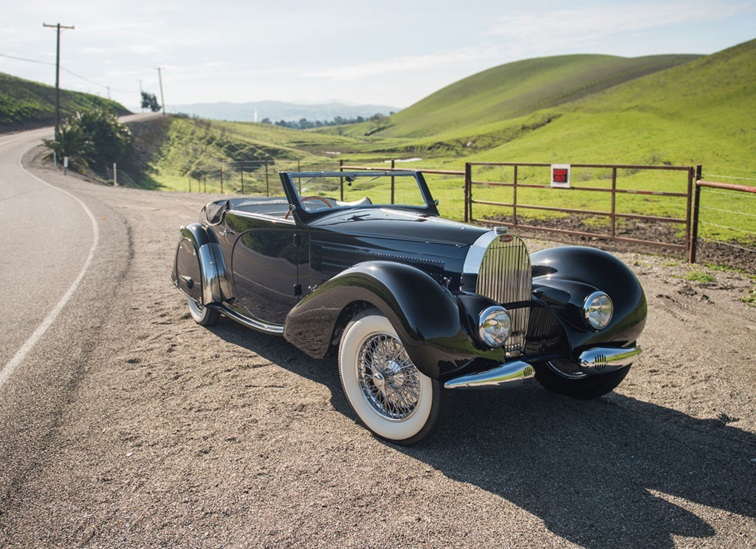
Bugatti Type 57 Stelvio 1936 - World Of Classic Cars -

Bugatti Type 57 Stelvio 1936

In the world of East Coast automobile collecting, especially in Florida, few people stood as tall for as long as the late Alexander E. Ulmann. His name is, of course, synonymous with Sebring, the first American automotive endurance race, which he established in December 1950, as well as with early efforts to establish the U.S. Grand Prix. However, his efforts in early U.S. automobile enthusiasm were not strictly limited to being a track-day impresario. Raised around Russia’s hydroelectric power plants and possessor of a Masters from MIT under Dean Fales, his business success in the burgeoning aeronautic and aerospace industries funded collecting that was as diverse as his life. Mercedes of 1908 and 1914 occupied the Ulmann garage, as did the famed marque Hispano-Suiza; but of his many automotive passions, few were as warm or as long-lasting as that for his Bugatti Type 57, chassis number 57406.
Bugatti Type 57 Stelvio 1936

According to Bugatti historian Kees Jansen, Ulmann’s Type 57 was built in April 1936; its body was, and remains, a four-passenger Stelvio, the attractive Jean Bugatti–designed cabriolet with its distinctive pontoon fenders and Atalante-like rounded tail. Typical of Bugatti, the Stelvio’s design evolved during Type 57 production. In 1935–36, the Stelvio sported a folding windshield and a top that would fold nearly flat and out-of-sight into a “cut-out” provided for it at the rear of the body. The result was streamlined, attractive, and sporting. It was an automobile that just seemed to have been designed to show off. Bugatti agreed, and sent chassis 57406 to the Nantes Fair, an international trade exhibition for everything from farm equipment to sports cars, which still exists today. On August 8, 1936, the car was sold to its original owner, R. Petit.
Bugatti Type 57 Stelvio 1936

Subsequently, the car made its way into the ownership of a Mr. Ferrand, by which time it had been upgraded with the later-style headlamps, integrated into the front fenders, as well as spats over the rear wheels. Period photographs from the 1940s, which are on file, show the car already fitted with these features, which in their design and construction seem very professional and true to later 1937–39 Bugattis. In addition, the car was also fitted with the front “moustache” bumpers, as well as Lockheed hydraulic brakes, which were a common upgrade to earlier cable-brake cars. All of this indicates that these modifications were either done by the factory or by a Bugatti agent.
Bugatti Type 57 Stelvio 1936

The Bugatti was sold by Mr. Ferrand to Jacques Dufilho, then a well-known actor living in the Latin Quarter of Paris. Additional very charming photographs on file depict the car during Mr. Dufilho’s long-term ownership, with members of his family obviously enjoying its good company. It was this last French owner who would sell the car, in 1974, to Alec Ulmann, in whose collection it would be maintained for the rest of the great sportsman’s life. He drove the car without the rear fender spats and refinished in light blue and black, as shown in a photograph taken in New York early in his ownership.
Bugatti Type 57 Stelvio 1936

The American Bugatti Registers by Andy Rheault and Sandy Leith note continued ownership by Mr. Ulmann until his passing in 1986. The Bugatti was retained by his widow, Mary, for two years and then was sold to a prominent collection on the West Coast. The car was then restored to its present appearance, updating its Ulmann two-tone royal blue and black “sweep panel” livery while fitting pale grey leather upholstery as a breathtaking contrast and reinstalling the “spats” on the rear wheels. The wire wheels were chromed, as had been available from Bugatti in 1937.

duminică, 28 februarie 2016

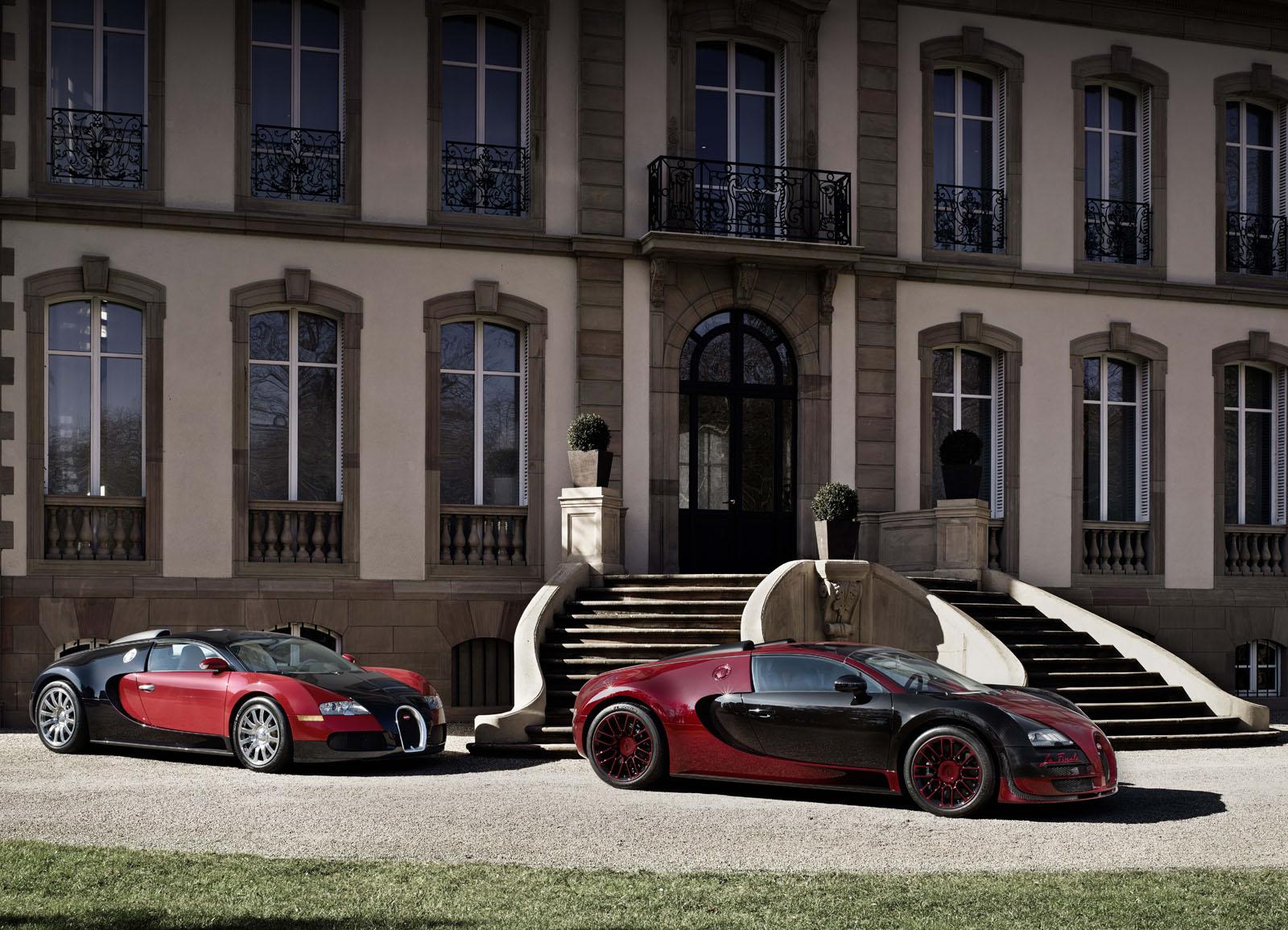
Bugatti Veyron Grand Sport Vitesse La Finale Photoshoot - World Of Classic Cars -

Bugatti Veyron Grand Sport Vitesse La Finale

sâmbătă, 20 februarie 2016

Bugatti Veiron Grand Sport Wei Long Edition Photoshoot - World Of Classic Cars -

Bugatti Veiron Grand Sport Wei Long Edition

vineri, 19 februarie 2016

Bugatti Veyron 16.4 Grand Sport "Bumblebee" Photoshoot - World Of Classic Cars -

Bugatti Veyron 16.4 Grand Sport "Bumblebee"

sâmbătă, 6 februarie 2016

Cars gallery - World Of Classic Cars -

Plymouth Hemi Cuda 1970
Cadillac Eldorado Brougham 1957
Volkswagen Samba Bus 23 Window Custom 1968
Shelby GT500 1968
Bentley Continental GT Mulliner 2005
Troy Custom 1959
Ford Ardun Hi-Boy Roadster 1932
Benetton Formula One 1996
Volkswagen Samba Bus 23 Window 1958
Rolls-Royce Phantom 2006
Rolland-Pilain Grand Prix 1930
Shelby Cobra CSX4891 1965
Pur Sang-Bugatti Type 51 1931
Lamborghini Countach 1989
Bentley Continental GTC 2007
Chevrolet Corvette Resto-Mod 1957
Porsche 911 Turbo DP 935 1986
Volkswagen Samba Bus 23 Window 1958
Factory Five GTM 2008
Dodge Challenger V-10 Resto-Mod 1970
Fiat Multipla 600 1960
Porsche 911 L 1968
Chevrolet Impala SS 1962
Maserati Mexico 1967
Porsche 911 Turbo 1994
Allard J2X MKII Factory Continuation 1952
Mercedes-Benz 190 SL 1959
Ford Mustang Boss 429 1969
Cadillac Eldorado 1955
DeLorean DMC-12 1981
Volkswagen Beetle 1956
BMW 2002 1976
Jeep Jeepster 1948
Fiat Abarth 850 SS 1971
Pontiac GTO 1964
Jaguar Mark IX 1960
Mercedes-Benz SLS AMG 2012
Cadillac Series 62 1949
BMW Isetta 600 1959
Spyker C8 2010
Mercedes-Benz S500 2004
Chevrolet El Camino 1971
Chevrolet El Camino 1967
Ford F-1 1954
Callaway Speedster 1991
Cadillac Eldorado 1953
Pierce-Arrow Model 81 1928
Ferrari 360 Spider 2002
Ford GT 2006
Ferrari F430 2008
Jeep Wrangler Unlimited Martini Hemi Edition 2013
Plymouth P9 1940
Cadillac 60 Special Fleetwood 1940
Ford Mustang Mach 1 32 1969