Se afișează postările cu eticheta Porsche. Afișați toate postările

luni, 16 mai 2016

Porsche 944 1989 - World Of Classic Cars -


The Porsche 944 was built from 1982 to 1991 on the same platform as the 924. The 944 was intended to last into the 1990s but major revisions planned for a 944 S3 model were eventually rolled into the 968 instead which replaced the 944. The 944 was a successful model and was available as both a coupé and cabriolet in naturally aspirated and turbocharged forms. In mid-1985, the 944 underwent significant changes.


These included a new dashboard together with new door panels, embedded radio antenna as well as some mechanical changes. Also included was a larger fuel tank, optional heated and powered seats, Porsche Hi-Fi sound system and revisions in the mounting of the transaxle to reduce noise and vibration. The numbers built, reflecting the popularity of the model, made it one of the most successful cars in Porsche's history.


This Porsche was originally registered on 10th March, 1989 and has recently been re-commissioned after a spell in storage. The current vendor has enthusiastically invested time and finances to ensure this 944 S2 presents in good condition. The blue coachwork has been 'refreshed' in places to a good standard and the matching velour interior trim is virtually unmarked.


vineri, 22 aprilie 2016

Porsche 356 B 1600 Coupe by Reutter 1963 - World Of Classic Cars -

Porsche 356 B 1600 Coupe by Reutter 1963

Porsche introduced its first car, ultimately referred to as the 356, in March 1948. Volkswagen-supplied running gear, suspension, brakes, steering, and gearbox underpinned the car, while Porsche modified the engine with redesigned heads and a Solex carburetor above each bank of cylinders on twin-port manifolds. About 50 hand-built coupes and cabriolets were produced between 1948 and 1950, with the company soon finding itself in need of better facilities in order to grow and prosper.
Series production began in March 1950. Demand quickly exceeded the original quota of 500 cars, with the company reaching that number just one year later. By March 1954, Porsche had built ten times its original estimate.
Porsche 356 B 1600 Coupe by Reutter 1963

The 356 A introduced in 1956 was an update of the original design. Included were a curved, one-piece windshield, more specialized Porsche components, and a greater choice of engines. This model remained in production through the 1959 model year.
Its successor, the 356 B, was introduced in September 1959 at the Frankfurt Auto Show. It featured higher front and rear bumpers, a raised front fender line, and higher-placed headlamps. Porsche reasoned that the higher bumpers would protect the bodywork in parking situations, and to this end, larger vertical bumper guards were fitted. The license plate lamp was removed from the rear of the body and placed in the rear bumper upper surface with small dual directional lamps. Small air intake grilles similar to those for the horns were placed in line with the horn grilles beneath the bumper at each ends of the car. The year 1963 saw 356 B production total 9,692 cars.
Porsche 356 B 1600 Coupe by Reutter 1963

According to the Porsche factory Kardex this 356 B was built on August 27, 1962, and delivered new through Hoffman Motorcars in New York to its original owner, Edward W. Ver Hoef, of Rockville, Maryland. The car was originally finished in Silver Metallic with a red vinyl interior. While its subsequent ownership history is currently unknown, it is reported that the Porsche spent much of its life in California. It is currently fitted with a period-correct, 60-horsepower 1600-series engine and four-speed manual transmission, along with the highly desirable factory sunroof option.
Porsche 356 B 1600 Coupe by Reutter 1963

Prior to its purchase by the consigner in 2007, the 356 B was professionally restored by Classic Showcase in Oceanside, California, to a high-quality driver standard in its original silver color. At that time, the engine and carburetors were rebuilt, the car was treated to new brakes, clutch, and suspension, and the gas tank was restored. The car was stripped to bare metal and painted with a base coat/clear coat finish, then color sanded, buffed, and fitted with a new black interior.

luni, 18 aprilie 2016

Porsche 911 Carrera RS 2.7 Sport Lightweight 1973 - World Of Classic Cars -

Porsche 911 Carrera RS 2.7 Sport Lightweight 1973

In the early 1970s, Porsche wanted to build on the success of its world-beating Type 917 endurance prototypes, but it faced a dilemma: the muscular five-litre 917 had been regulated out of existence by the FIA, which set a new displacement maximum of three litres for the World Championship of Makes. In response, Porsche’s competition department decided to create a small series of purpose-built race cars based on the production 911 for the FIA’s Group 5 Special Grand Touring class. They would be called the Carrera 3.0 RSR. To meet the FIA’s Group 5 regulations, a minimum of 500 street-legal Group 4 cars would have to be constructed and sold within one year. To emphasise the car’s racing heritage, they were dubbed the Carrera RS and two versions would be offered, the M472 Touring, which had a great deal of standard 911 S equipment, and the stripped-down M471 Sport, which was more commonly known as the Lightweight.
Porsche 911 Carrera RS 2.7 Sport Lightweight 1973

To Porsche’s amazement, the first run of 500 cars quickly sold out on word-of-mouth, even before the Carrera RS made its public debut at the 1972 Paris Auto Show. A second run of 500 units was approved, comprised mostly of Touring versions. The company, realising that the first cars had been under-priced, boosted the retail price by another 1,000 Deutschmarks, but these, too, quickly sold, and a third run was completed at an even higher price. Eventually, a total of 1,590 Carrera RSs (including prototypes and homologation units) left the factory.
Porsche 911 Carrera RS 2.7 Sport Lightweight 1973

The Carrera RS Touring and its competition-oriented sister made extensive use of lightweight materials. Fiberglass was used for the engine cover and front and rear bumpers (Series 2 Touring models had steel rear bumpers). The rear quarter panels were artfully widened to accept wider seven-inch wheels and tyres (the front wheels remained six inches wide). What was to become the RS’s trademark feature, the “ducktail” rear spoiler, was added to the engine cover after wind-tunnel testing had demonstrated that it was very effective at increasing high-speed stability by reducing rear-end lift.
Porsche 911 Carrera RS 2.7 Sport Lightweight 1973

Whilst the Touring version was intended for road use, the M471 Lightweights were aimed at club-level racers. This very exclusive series, of which only 200 were produced, scaled only 975 kilograms, about 100 kilograms less than the Touring model, which was accomplished through the utilisation of thinner-gauge steel for their wings, roof panel, and doors and thinner and lighter (and very expensive) clear glass from the Belgian firm Glaverbel. This special glass was fitted to most Series 1 Lightweights but only a few from the second series where available with this option. There was no sound insulation, and only very thin carpeting and simple rubber mats covered the floor, whilst the rear folding seatbacks, sun visors, dashboard clock, radio, and glovebox door were deleted.
Porsche 911 Carrera RS 2.7 Sport Lightweight 1973

The standard armrests and latch handles were replaced by simple plastic pull handles and pull-cord door releases. As the story goes, Tony Lapine’s styling department conceived the now-famous “negative” Carrera side striping after Lapine happened to glance at the negative of a photograph taken of the car wearing its originally planned “positive” lettering.
The heart of the Carrera RS was a new six-cylinder engine of 2.7 litres. The 2.4-litre 911 S’s 70.4-millimetre pistons and cylinders were replaced with 90-millimetre aluminium barrels which were coated with Nikasil (Nickel-silicon carbide) for improved lubrication and wear characteristics. With this increased displacement, 8.5:1 compression, and Bosch mechanical fuel injection, the new Type 911/83 engine developed a reliable 210 brake horsepower at 6,300 rpm and 202 foot-pounds of torque at 5,100 rpm. Also new was the stronger Type 915 five-speed manual transmission, which replaced the old Type 901 with its “dog-leg” first gear.
Porsche 911 Carrera RS 2.7 Sport Lightweight 1973

This beautiful Series 2 Carrera RS Sport was the 649th RS built and amongst 160 finished in Light Ivory (code 131). It was trimmed with red Carrera graphics and the spokes of the anodised Fuchs forged alloy wheels were painted to match. The interior was a black leatherette, and as a Lightweight, this RS was fitted with a pair of Nylon-upholstered Recaro competition seats with adjustable headrests. There is a mix of Glaverbel and Sekurit glass, and the backlight is heated. The car was delivered with several items that are included on the Touring version, such as a glovebox door and a standard Porsche badge on its bonnet instead of a decal. The lightweight rear lid has a pair of rubber hold-downs as well. Only a few options were specified, including a 40-percent limited-slip differential. Per usual, both the clock and radio were deleted.
Porsche 911 Carrera RS 2.7 Sport Lightweight 1973

Chassis 600649 left the factory on 1 February 1973 and was shipped through Porsche’s Italian distributor to a dealer in Torino. It enjoyed long-term ownership by two local enthusiasts before coming into possession of ITALCLASSIC, a company owned by the former president of the ASI (Automotoclub Storico Italia), Vittorio Zanon (ASI President 1987–1997), and managed by Maurizio Tresoldi on his behalf. In 1995, it was acquired by the present Italian owner. He more recently embarked on a complete restoration of the Carrera RS, entrusting it to Porsche specialists at Tirelli Motorsport in Turin. This time-consuming work was recently completed at a cost of some €225,000 and included a complete disassembly and stripping of the tub to bare metal, a fresh re-spray in the car’s original and correct colour, the installation of a new interior, and a complete mechanical overhaul.

duminică, 17 aprilie 2016

Porsche 911 S 2.4 Targa 1973 - World Of Classic Cars -

Porsche 911 S 2.4 Targa 1973

Amongst the most desirable of the early Porsche 911s must certainly be the 1973 911 S 2.4-litre, the final production year of the elegant long-bonnet/narrow bumper F-series, along with the ’73-only Carrera RS.
Despite the increased displacement of the 2.7-litre RS, this 2.4-litre S shares many of the same features of the 2.7, such as the new and stronger 915 gearbox, light aluminium brake callipers, a front-mounted oil cooler, and the optional 85-litre plastic fuel tank that was only found in the RS. Due to the increased fuel capacity, the spare wheel is one of the very first space-saver versions, dated 12/72. Of course, the 1973 Carrera RS is significantly little lighter and puts out an additional 20 horsepower, but the performances of these two cars is strikingly close. Of course, the quality and performance of the 2.4 S in relation to price of the 2.7 RS makes this an unbeatable opportunity.
Porsche 911 S 2.4 Targa 1973

Presented here is the 464th of 925 F-series Targas built in 1973. It was sold by JV Porsche in Verona, Italy, where its first owner took delivery. It remained in the same region for the first 37 years, until 2010, when it was acquired by the current owner. Currently, the car is still in its very original condition, and the consignor notes that no evidence of rust repairs or prior accident damage appears anywhere on the car. A cosmetic restoration, under the care of its previous owner, was completed by specialists in Modena, Italy. The restoration work included a flawless repaint in the car’s original colour of Hellelfenbein (Light Ivory) and the installation of a complete new black leather interior, as well as factory grey knitted carpets. All four correctly date-stamped wheels have been restored and anodised to a factory finish by specialists at Art Wheels in France, and recently, the car has been fitted with new and period-correct 185/70-15 Michelin XWX tyres. The chrome trim and factory-tinted windows are still in their original condition, whilst some fading of the factory galvanising shows authentic patina, which supports the overall originality of this car.
Porsche 911 S 2.4 Targa 1973

Furthermore, this 911 S Targa is fitted with a number of desirable options, including twin headrests for the factory comfort seats, a correct Blaupunkt stereo system, rear-seat original REPA seatbelts, and dual mirrors.

vineri, 8 aprilie 2016

Porsche 356 B 1600 S Cabriolet by Reutter 1960 - World Of Classic Cars -

Porsche 356 B 1600 S Cabriolet by Reutter 1960

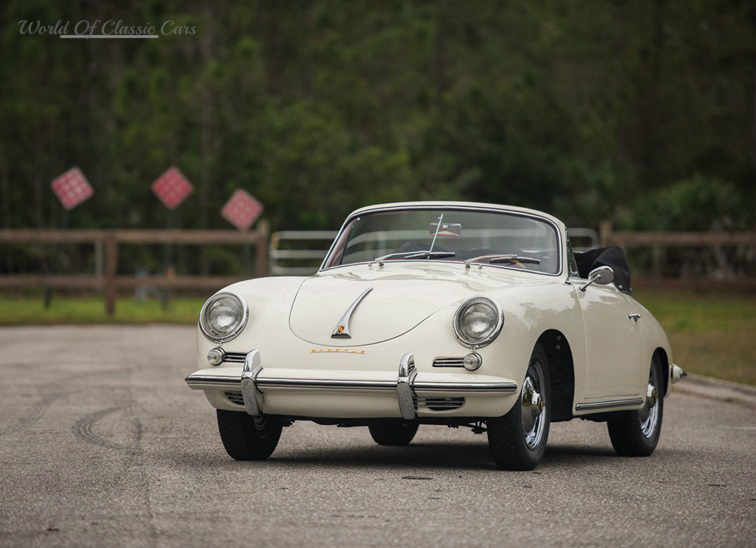
Porsche 356 B 1600 S Cabriolet number 152629 was completed on October 16, 1959, finished in Light Ivory over a red leather interior and supplied for U.S. delivery with both a removable hardtop and a folding soft top, as well as the twin-carbureted 1600 “Super” engine. The formal order for this Porsche was placed on November 11, 1959, and it was sold on December 5, 1959, to Dr. Keith Neece. On January 5, just one month after taking delivery of his new 356 Cabriolet, he traded it in to the local Ford dealership, most likely for something a bit more practical for the Chicago winters!
Porsche 356 B 1600 S Cabriolet by Reutter 1960

Soon thereafter, a recent graduate from the University of Illinois found himself looking for just such a Porsche. It also just so happened that his father was the Ford dealership’s Sales Manager. James Richard Kerr, an aeronautical engineer, and his recent bride, Shirley Ann, purchased the car later that month. Jim and Shirley remained in Illinois with this Porsche until he accepted a position with Ryan Aeronautical in San Diego in the fall of 1963. They loaded up their possessions and drove the 356 across the country to their new home in California. In 1966, the car developed an engine problem at around 56,000 miles. As the Kerrs debated how to resolve the issue, the Porsche was placed in storage, where, as fate would have it, the car remained until 2011.
Porsche 356 B 1600 S Cabriolet by Reutter 1960

After that 45-year residence, the 356 was purchased from the Kerrs’ son by an enthusiast in San Diego, next passing to an avid Porsche collector in Florida. A two-year restoration by marque experts was begun in 2012, with the goal of preserving as much of the original components of the car as possible. Necessary repairs to the bodywork and fresh Light Ivory finish were applied by Alton Jones of Columbia, South Carolina. A new red leather interior with correct German square-weave carpeting and a new top and boot were installed by Jean-Noël Gieffeuille of Pittsboro, North Carolina, and a complete mechanical overhaul of the original engine, transaxle, and brakes was completed by Paul Willison Werkstadt in Lake Park, Florida. The instruments were properly restored, and the car was fitted with a new windshield and wiring. The brightwork was also re-plated or polished as necessary.
Following its restoration, this gorgeous cabriolet was shown at the 2013 Porsche Parade in Traverse City, Michigan, scoring 296 out of 300 points and earning a Zuffenhausen Award.

joi, 7 aprilie 2016

Porsche Carrera GT 2005 - World Of Classic Cars -

Porsche Carrera GT 2005

Looking to return to the 24 Hours of Le Mans, Porsche sought to develop a replacement for their class-winning 911 GT1 in hopes of more success at the Circuit de la Sarthe. Unfortunately, partway through development, a change in FIA rules forced the racer to be shelved. However, Porsche did not let their newest creation go to waste and eventually decided to develop the platform for road use thanks to additional revenue from the Cayenne, creating the Carrera GT.
Utilizing a carbon-monocoque engine fitted with a naturally aspirated V-10, carbon-ceramic brakes at all four corners, and even a cutting-edge carbon-fiber racing clutch, the Carrera GT was laden with a mesmerizing assortment of lightweight racing-derived components. Originally developed by Porsche for the Footwork Formula One team, the mid-mounted engine is paired with a stainless-steel exhaust system to produce a sound similar to that of an F1 car on the Nürburgring. This would be the first V-10 engine used in a Porsche, and it proved to be the defining feature of the automobile, providing the car with not only a breathtaking soundtrack but also incredible performance.
Porsche Carrera GT 2005

Although Porsche’s initial press release reported the Carrera GT to move from 0–60 mph in just under four seconds, Car & Driver found it to be an astonishing 3.5, with a quarter-mile sprint in an equally impressive 11.2 seconds. Compare this to the identical quarter-mile time of 11.2 seconds from the Enzo, Ferrari’s flagship supercar of the same era. However, the Enzo had an MSRP just shy of $660,000, while the GT was originally sold for considerably less—$448,000—giving it a greater bang for your buck than its Italian counterpart.
The Carrera GT presented here is the 949th example of only 1,270 examples produced. A one-owner vehicle, this GT was meticulously maintained by a Porsche and Ferrari collector and has resided in Beverly Hills, California, ever since it came off the line.
Porsche Carrera GT 2005

When new, journalists hailed the Carrera GT as one of the greatest supercars of all time, as it featured incredible performance in a lightweight, race-ready package that had gorgeous bodywork. Even 10 years after the first car was produced, it is still remarkably exciting to drive, and ownership of a Carrera GT has become a goal of many Porsche aficionados.

Porsche 911 Turbo Coupe 1989 - World Of Classic Cars -

Porsche 911 Turbo Coupe 1989

Porsche began experimenting with turbochargers in the late 1960s. However, it was not until 1975 when a road-going model, the 911 Turbo, was introduced. Initially only available in Europe, it was so vastly different than the 911 from which it was derived that it received its own internal designation, the Type 930. The new car was federalized for the U.S. and debuted in 1976 as the Turbo Carrera. Claims as the fastest production car in America were quick to materialize as performance was truly impressive: 0–60 mph in 4.9 seconds, the quarter-mile in 13.5 seconds, and a top speed of 156 mph.
Porsche 911 Turbo Coupe 1989

Power was initially supplied by a 3.0-liter flat six and mated to a wide-ratio four-speed manual transmission. Outside, the car was identified by a signature “whale-tail” spoiler and the massively flared wheel arches. A beefier chassis, Bilstein gas shocks, and an oil cooler were standard. Over the years, the car was refined, and horsepower (and price) increased steadily.
By 1986, the engine had been upsized to 3.3 liters, and Targa and Cabriolet versions became available for 1987. Beginning in October 1988, a five-speed manual transmission with hydraulic clutch was made standard. For the final year, the Turbo featured firmed-up suspension componentry to improve driving response. Rear-suspension torsion bars were increased in diameter, while front and rear anti-roll bars were increased in thickness, and damper settings were made firmer.
Porsche 911 Turbo Coupe 1989

The car presented here is one of only 639 Turbo coupes imported to the United States of a total 1,496 produced for the final 1989 model year; it is a late-build car, in a year where production was shortened to just nine months. It is a remarkable time capsule of Porsche’s ultimate expression of performance. Painted in ever-appropriate Guards Red, accented by black Fuchs wheels, over a Cashmere Beige and Black partial leather interior, this is the quintessential color scheme revered by Porsche aficionados. Equipped with air conditioning and power windows, as well as the optional sunroof and Blaupunkt Reno AM/FM Stereo/Cassette with amplification, this Porsche is both stylish and fast…and comfortable.

duminică, 3 aprilie 2016

Porsche 911 Turbo 1979 - World Of Classic Cars -

Porsche 911 Turbo 1979

This highly original 911 Turbo is the 848th of just 1,200 M-Series, U.S.-specification Turbos produced for 1979. But more importantly, this car has been driven just 548 miles at the time of cataloguing, making it one of the most original and unmolested examples available.
Delivered new by Moore Porsche-Audi in Philadelphia, Pennsylvania, this amazing Turbo was soon put into dry storage and is offered in virtually as-new condition. Its gleaming Silver paint with black anodized exterior trim and door handles is complemented by a black leather interior (with off-white headliner), deeply-bolstered sport seats, and special “Turbo” carpeting. As befits Porsche’s top-of-the-line 911, the Turbo was fully equipped with a limited-slip differential, an electric sunroof, electric windows, air conditioning, a rear window wiper, heated and electrically adjustable outside mirrors, fog lights, and a stereo entertainment system.
Porsche 911 Turbo 1979

Fitted with thermal reactors to reduce exhaust emissions, the Type 930/60 engine was enlarged to 3.3-liter displacement in 1978 and produced a healthy 265 brake horsepower with the help of a large intercooler. Because this engine produced so much torque, Porsche decided to use the sturdier four-speed manual transmission rather than the five-speed gearbox of lesser models. Its outrageous fender flares were emphasized by black gravel guards on the rear and silver-anodized seven-inch- and eight-inch-wide forged Fuchs alloy wheels with black-painted center spokes. A large rear “whale-tail” spoiler with rubber edging provided both space for the intercooler and significant downforce. The Turbo delivered outstanding road performance, with stunning acceleration and a top speed approaching 160 mph. On its introduction in 1975, the Turbo became Porsche’s flagship and image leader, the fastest production car it had ever created.
The original purchaser retained this magnificent 930 Turbo until 1987, when it was sold to its second owner, who held onto it until 2015, when it came into the hands of the consignor.

Porsche 356 B Super 90 Roadster by Drauz 1960 - World Of Classic Cars -

Porsche 356 B Super 90 Roadster by Drauz 1960

Porsche’s popular 356 Roadster was introduced for the 1960 model year as a replacement of the one-year-only Convertible D, the Speedster’s more civilized successor. The new T-5 Roadster brought several marked changes in appearance; the front fenders and headlamps were raised, as were both the front and rear bumpers, to better deal with urban parking, and new vertical bumper guards also helped in that respect. New brake-cooling intakes were also added to the nose below the front bumper. There were new cast-aluminum Alfin brake drums with iron liners, and the brakes had improved sealing to repel water.
Porsche 356 B Super 90 Roadster by Drauz 1960

The new Roadster shared many of the comfort attributes of the Convertible D, including roll-up windows, comfortable seats, and a well-constructed convertible top with a tan-painted frame and wraparound plastic rear window. For those with competition in mind, the windshield could be removed, and Roadsters, like the Speedster and Convertible D, soon became popular in amateur sports car racing around the world.
The Roadster presented here is finished in its original Ivory color, with the correct red interior and black top. It previously belonged to noted Porsche restorers Harvey and Linda Smith for 32 years and features the desirable Super 90 engine. Prior to the Smith’s ownership, it belonged to David Koehn of Milwaukee, Wisconsin, who acquired the car in 1975. He advertised it for sale in the Porsche Panorama magazine, where Linda spotted her dream car. Harvey flew to Wisconsin to collect it, though, unfortunately, the engine failed on the way home to Arizona, so Smith fitted a 1962 Super 90 motor, which remains in the car today. Sadly, Linda Smith never did drive her dream; its restoration was unfinished when she passed in 2005.
Porsche 356 B Super 90 Roadster by Drauz 1960

Thereafter, Smith sold the Roadster to Ibrahim Kuzu in Texas in 2007. Kuzu ultimately found another project to pursue and sold the car to Wisconsin collector Carl Zapffe in 2009. The Roadster was then sent to Terry Worick Restoration in Eagle, Nebraska, where it received a complete bare-metal rotisserie restoration. Zapffe then enjoyed his stunning Porsche for another six years before it was acquired by the current consignor. A stickler for perfection and detail, he engaged Classic Restorations of Denver, Colorado, to repaint the Roadster to rectify any nagging concerns. Today, the paint is excellent and the bodywork exceptionally straight, with outstanding panel fit. As the hood had been initially poorly repaired, it was replaced with a new unit. The interior was also refinished in red leather by Monaco Auto Trim of Englewood, Colorado, which fitted correct red carpet and a black Haartz top. New step plates and door seals were installed and a new windshield fitted. The chassis and drivetrain were detailed to concours standards, while the brakes and Super 90 engine were fully rebuilt during the previous restoration work, and new shocks and tires were fitted.

sâmbătă, 2 aprilie 2016

Porsche 550 Spyder by Wendler 1955 - World Of Classic Cars -

Porsche 550 Spyder by Wendler 1955

‘Design is not simply art, it is elegance of function’ – Ferdinand Porsche

THE GIANT KILLER

The 550 Spyder put Porsche firmly on the map as a serious competitor on the world’s racing tracks; indeed, the diminutive mid-engined roadster generated the nickname ‘Giant Killer’ for its ability to defeat much more powerful rivals. Introduced at the 1953 Paris Auto Show, the 550 and its second iteration, the 550A, remained in production through February of 1959, and a total of 130 chassis were constructed before the 718 RSK Spyders appeared. A large proportion of 550 production was destined for the United States.
Porsche 550 Spyder by Wendler 1955

Built on a frame of seamless mild steel tubing, the 550 utilised a front suspension of double trailing arms and transverse-leaf torsion bars. After the first few examples, the rear suspension was redesigned from leading control arms to trailing arms with swing axles and tubular transverse torsion bars. Porsche’s engineers had planned an all-new engine to power the Spyder at the gruelling Carrera Panamericana, but early testing determined that Dr Ernst Fuhrmann’s Type 547 advanced 1.5-litre air-cooled four-cylinder Boxer engine was not quite ready. Thus, the first few chassis were fitted with conventional pushrod Porsche engines. Soon, however, reliability was ensured and the new ‘Four-Cam’ would be installed in all the 550s, 550As, RSKs, 356 Carreras, and 904s that were to follow.
Porsche 550 Spyder by Wendler 1955

This marvellous but complex engine, called the ‘Drawer motor’ because its engineering drawings were quickly hidden in Fuhrmann’s desk whenever Dr Porsche walked into his office, was an all-alloy unit displacing 1,498 cubic centimetres. Its camshafts were driven off the Hirth-patent built-up roller-bearing crankshaft by a series of shafts and crown wheels. Cam timing took dozens of man-hours to properly establish, but once all the clearances were correctly set, the high-revving motor was very reliable. It featured dry-sump lubrication and two spark plugs per cylinder. With compression of 9.5:1 and breathing through a pair of Weber downdraft carburettors, this engine produced a strong 110 brake horsepower. In a chassis that weighed barely 590 kilograms, 550s were capable of top speeds approaching 210 km/h (140 mph), dependent on gearing. Because these little roadsters were ostensibly required to be street driven, they were fitted with a token canvas tonneau that met the letter of the rulebook but were otherwise better left folded away in the garage.

CHASSIS NUMBER 550-0068
Porsche 550 Spyder by Wendler 1955

This beautiful 550 Spyder left the factory at Zuffenhausen on 19 September 1955, to be eventually delivered to an American customer, but first, there would be an intermediate stop: Porsche’s stand at the 1955 Frankfurt Motor Show. There, it shared the company’s display with a 356 Speedster, a coupé, and a cabriolet. Chassis number 550-0068 was shown in semi-racing form; that is, there was a small racing windscreen to protect the driver and an alloy half tonneau covering the passenger side of the cockpit. Suggesting, perhaps, that this was a dual-purpose sports car, it was also fitted with moon hubcaps, which were standard fitment to cars delivered in street trim. Adding to the sporting impression that Porsche wanted to convey, the rear fenders were topped with painted ‘darts’, or flashes. Today 0068 has been restored to its original silver paint with light blue darts, a very attractive combination.
Porsche 550 Spyder by Wendler 1955

The factory build sheet specifies that 0068 was to be shipped to ‘1 kunde/customer USA’ following the Frankfurt show. That customer was a gentleman named Mike Marshall, a Porsche/Volkswagen dealer and amateur racer of Miami, Florida. Mr Marshall wasted no time in putting his new 550 to the task for which it was intended. Just two months after the car starred on Porsche’s display at Frankfurt, Marshall gave the new Spyder a victory in its first outing, an SCCA race at Waterboro, South Carolina. Next up was December Speed Week at Nassau in the Bahamas, where Marshall finished 6th in the preliminaries, dropped out of both the Governor’s Cup and All-Porsche contests, but came back to score a respectable 4th place in the Under-Two-Litre Production race. In February 1956, Marshall won a pair of SCCA Regional races at Punta Gorda, Florida; a 1st and 2nd at Waterboro; and then, sharing the wheel with Porsche’s racing chief and occasional driver Huschke von Hanstein, managed a creditable 14th overall and 3rd in class at the Sebring 12 Hours. Von Hanstein was quite familiar with 0068; he had posed with it at the Frankfurt Motor Show.
Porsche 550 Spyder by Wendler 1955

Through the remainder of 1956 and early 1957, Marshall ran numerous other amateur races including Elkhart Lake, Wisconsin; Montgomery, Alabama; Chester, Carolina; Gainesville, Florida; the 1956 Nassau Speed Week; and then a race weekend at the very difficult 2.4-mile circuit at New Smyrna Beach, Florida. Unfortunately, in a preliminary event, Marshall had an off, side-lining the Spyder for the weekend. Fifteen months later, 0068 was sold to Joe Sheppard, a very talented amateur who’d picked up the nickname ‘The Tampa Hotshoe’ and who drove the car at Chester and Gainesville. The car’s racing history then lists Sheppard’s friend Duncan Forlong, who borrowed the car for two races at Dunnellon Park, Florida.
Porsche 550 Spyder by Wendler 1955

It is believed that 0068 then remained in Florida. When recently quizzed about the car, Joe Sheppard could not recall exactly when it was sold; it was a deal put together by his father. The new owner is believed to have been Bob Ross, who made a regular appearance at the Sebring track with racing friends in his new Spyder. In the mid- to late-1980s, the Porsche was bought by Lynn Larson, who almost immediately sold it on to his friend Phil Bagley, who then sold the car to its new owner who shipped it to Italy.
The car was inspected on 12 November 1989, by a Mr Parigi, prior to issuance of FIVA license number 0120620 by the Automotoclub Storico Italiano. That registration process was not completed until 21 April 1997. Italian registration number BG-B67015 was assigned 28 August 1997 in the name of Pierluigi Bartoli of Riva di Solto, who had acquired the car in July of 1993, per the Estratto Chronologico. In 1999, the current owner, an Italian businessman and enthusiast, purchased this historic racer.

Porsche 356 Pre-A Speedster by Reutter 1955 - World Of Classic Cars -

Porsche 356 Pre-A Speedster by Reutter 1955

The 356 forever defined Porsche as the maker of lightweight, technically advanced sports cars. It was the brainchild of Ferdinand Porsche, son of the company’s founder, who wanted to explore the design possibilities of an air-cooled, rear-engined, rear-wheel-drive car. He believed a lightweight sports car could be created from a pan and body construction and that excellent traction would result from a rear-engined car.
A mere 1,233 examples of the “pre-A” Speedster were produced in 1954 and 1955. The car presented here left the Zuffenhausen production line in March 1955, and a copy of the original Kardex order sheet details that the importer Max Hoffman ordered the vehicle with an ultimate destination of California, where the vehicle spent its early life.
Porsche 356 Pre-A Speedster by Reutter 1955

The quest for greater performance led to the fitting of a later 1600 S (Type 616/2) engine from a 1958 example. This upgrade was a popular improvement, as the “S” engine offered better delivery of more power. The car was also subject to a recent comprehensive restoration and is finished in a stunning metallic grey, and it features the lightweight racing seats finished in contrasting red leather with matching door cards and hood. As part of the restoration, the engine was given a major overhaul with the aim of creating the ultimate unit using the best period tuning techniques. The specification included specialist upgraded parts from Joma, such as a special camshaft, ported valves, and Weber carburettors, and every moving part was balanced to optimise output. A recent dyno test, the results of which are included in the car’s file, was confirmed to be a very potent 100 horsepower.
Porsche 356 Pre-A Speedster by Reutter 1955

The result is a 356 that is the ultimate creation of a period California amateur racecar that defined the Porsche heritage and set the benchmark for every sports car the company has created since. This immaculate, much sought-after model is ideal for touring and events, which, combined with its place in Porsche history, makes it a must for an enthusiast collector.

Porsche 911 Carrera RS 1992 - World Of Classic Cars -

Porsche 911 Carrera RS 1992

Delivered new in Italy, this beautiful N-program Type 964 Carrera RS coupé is one of fewer than 2,000 standard N-program RS coupés produced. Unlike the competition variant or the Carrera Cup racers, the streetable Carrera RS was a reasonably civilised and true dual-purpose Porsche. As such, many were put to use in club track events and national series. The lightweight RS was powered by a Type M64/03 air-cooled dry-sump six-cylinder 3.6-litre engine. With 11.3:1 compression and Bosch Motronic-controlled sequential fuel injection, the potent engine developed 260 horsepower at 6,100 rpm.
Porsche 911 Carrera RS 1992

These engines were prepared with matched pistons and cylinders, and all reciprocating parts were carefully balanced. They were fitted with Getrag-built G50/10 transmissions fitted with taller first and second gears, steel synchroniser rings, and altered shift sleeves. Asymmetrical limited-slip differentials, borrowed from the Type 930 Turbo, delivered a 20 percent lockup under acceleration and 100 percent under braking. The driver also enjoyed a “short” gearshift linkage. Instead of the 964’s usual dual-mass flywheel, the RS had a racing flywheel that was seven kilograms lighter than standard.
Porsche 911 Carrera RS 1992

The competition-oriented suspension comprised front McPherson struts, light-alloy transverse control arms, coil-over shocks, and an anti-roll bar, while in the rear could be found adjustable aluminium semi-trailing arms with coil-over shocks and an anti-roll bar. The RS was equipped with magnesium-alloy “Cup” racing wheels, 7.5J and 9J by 17-inch diameter, shod with 205/50 and 255/40 ZR-rated tires. Curb weight was stated as 1,220 kilograms or a mere 2,684 pounds. For a street-legal automobile, the 964 Carrera RS was seriously quick, offering 100 km/h from a standing start in just 5.3 seconds.
Porsche 911 Carrera RS 1992

The Carrera RS presented here was delivered October 17, 1991, and was sold new to Citicorp Finanziaria S.p.A. Citifin of Milan, Italy, the following January, registered as FI L80100. In November of 1993, it was sold to noted soccer coach Nicola Ferrini and then either sold or traded in to SA.MO.CAR Sport Auto Roma, the Rome Ferrari dealer, in August 1996. Its next owner was Pierfrancesco Freré of Team Nuvolari of Rome in December 1997, who raced the car at least twice. Then, in October of 1999, it was bought by Porsche racer Luca Aiazzi, who also successfully competed with the RS, finishing 2nd in the Italian Porsche Super Sprint in 2002. It then passed to Sauchelli Auto in Caserta in July 2003 and then to Algi Car in Lucca the following October. The current Italian owner acquired the Carrera RS in early 2007.

joi, 31 martie 2016

Porsche 911 Speedster 1989 - World Of Classic Cars -

Porsche 911 Speedster 1989

The 911 Speedster was first conceived in 1983 as a simpler, lighter, and less expensive open model that could be used as a fair-weather tourer or a track car, much like its spiritual predecessor, the 356 Speedster. The new Speedster would be so spare that it would not even have a top. What it would have is the aggressive look that included front fenders, quarter-panels, and wide alloy wheels borrowed from the 930 Turbo. With a sharply angled, cut down, removable windshield and the rear of the cockpit covered by a fiberglass tonneau cover, it offered quite an outrageous appearance, credited to Porsche stylist Tony Lapine.
Porsche 911 Speedster 1989

A second prototype was built in 1986 and was unveiled as a 911 SC-based concept at the 1987 Frankfurt Auto Show, where it drew a great positive response. Porsche management decided to build the Speedster as a limited-production model on the next-generation Type 964 chassis then under development. However, when manufacturing delays slowed the 964’s introduction, the new Speedster was built on the 3.2-liter Carrera chassis, which was nearing the end of production.
The Speedsters were equipped with the H-program’s 3.2-liter air-cooled flat six engine, which developed 217 brake horsepower. Power was fed through a five-speed Getrag G50 transaxle, and there were power-assisted, ventilated, and cross-drilled disc brakes with alloy calipers at all four corners. Turbo-look Speedsters were fitted with 7J and 9J 16-inch-diameter Fuchs forged alloy wheels and larger tires. Beneath the fiberglass rear tonneau, the rear seats were replaced by a carpeted storage area.
Porsche 911 Speedster 1989

Completed June 6, 1989, this example spent most of its life in southern California, having been imported by its first owner, who picked up the car at the factory under Porsche’s Tourist Delivery program. It was delivered in the popular color of Guards Red with a black partial leather interior and was factory-equipped with air conditioning, sport seats with electric height adjustment, a short shifter, a Blaupunkt Charleston stereo, and a security system.
On June 8, 2000 the car was sold by Porsche of Newport Beach to who is believed to be the car’s second owners, Mr. and Mrs. Richard Salvi of Trabuco Canyon, California. Mr. Salvi immediately had the car serviced and all lubricants replaced by marque specialist Andial Road and Racing in Santa Ana, and, later in his ownership, he replaced the factory stereo with a Kenwood unit in late 2000. In August 2004 the car was returned to Andial for new hood shocks, new rear shock absorbers, new steering column bushings, a new battery, and other items. The Salvis retained the car until 2014.

miercuri, 30 martie 2016

Porsche 911 S 'Soft Window' Targa 1968 - World Of Classic Cars -

Porsche 911 S 'Soft Window' Targa 1968

When Porsche rolled out its 1968 model line, it faced a daunting problem: new U.S. safety and emission standards. The “S” engine from 1967 was a high-performance motor in all respects. With high-compression forged alloy pistons, forged and nitrided connecting rods, large valves, and big Weber triple-throat carburetors, it produced a healthy 160 horsepower. Porsche soon realized that this motor would probably not comply with the new U.S. emissions standards without additional development. Careful tuning would eventually resolve that problem, but Porsche did not have time to establish those procedures in time to allow delivery of the new 911 S to its most important market and could not risk shipping new cars that it could not legally sell.
Porsche 911 S 'Soft Window' Targa 1968

Management decided to restrict the 1968 “S,” identical to the 1967 version, to Europe and instead offer American customers the one-year-only 911 L, with an air pump-equipped engine producing a lesser 130 brake horsepower. Over time, a small number of European-spec 1968 S coupes and Targas have been imported to the U.S., where they enjoy special recognition.
Presented here is one of the finest available, in “soft-window” Targa form. The European-delivery example was completed May 15, 1968, and finished in attractive Blutorang (Tangerine) with a black removable fabric top panel and black leatherette interior, set off with a brushed stainless steel roll-over hoop and gold-plated trim. The only factory option noted on its Certificate of Authenticity was a set of Dunlop 165-15 SP radial tires.
Porsche 911 S 'Soft Window' Targa 1968

The Porsche eventually came into the ownership of the consignor, who commissioned an exacting bare-metal restoration, which would involve a veritable who’s who of Porsche experts and generate some $90,000 in receipts. The car was entrusted to Scott Klepinger Classic Cars in Elkhart, Indiana, where it was stripped to a bare shell. Every detachable component was rebuilt, repainted, re-plated, or replaced with OEM or correct replacement parts under the supervision of marque specialist James Schrager. The car was repainted its original color, and the interior was replaced with new seats, door cards, dashboard trim, and carpeting. There is a new windshield, new engine grille, and new Targa roof and zip-out rear window.
Porsche 911 S 'Soft Window' Targa 1968

The two-liter Type 901/7 engine and Type 901 five-speed transmission were completely rebuilt by Marty Hostetler of Bristol, Indiana. The carburetors and distributor were rebuilt by PartsKlassik. A new flywheel, clutch, and starter were installed, along with a new wiring harness and electronic ignition. The brakes were overhauled with a new master cylinder, rotors, and stainless lines. Additionally, the suspension was rebuilt with new Koni struts and shocks, and new Michelin tires were mounted on 5.5-inch Fuchs alloy wheels.