Se afișează postările cu eticheta Lancia. Afișați toate postările
sâmbătă, 21 mai 2016
Lancia Ardea 1952 - World Of Classic Cars -
Introduced in 1939, the Lancia Ardea featured a 903cc, V4 power plant with an alloy cylinder head and became the smallest production V4. In 1948, the third Series Ardea became the first mass produced motorcar to feature a five-speed gearbox. The unitary construction included a pillarless section between the doors.
Due to its small size, this allowed ease of access to the rear passenger compartment. Every Lancia Ardea was built in righthand drive; Lancia not manufacturing a production lefthand drive vehicle until 1955. Production of the Ardea ceased in 1953 with nearly 23,000 examples being produced.
This lovely third Series Lancia Ardea is presented in very good order having undergone restoration works in the past. The grey coachwork is particularly attractive and is complimented by the excellent West of England cloth interior whilst the interior still features the original rubber floor mats. The exterior alloy details such as the door handles, boot lock and various other trim items are all excellent although the alloy bumpers may be said to have seen some action!
To aid safety on today's roads, front and rear indicators have been added and mounted below the bumpers although the standard semaphore indicators located on the upper C-pillars both operate correctly. On the road, this little Lancia performed well maintaining a steady 50mph with ease.
The hydraulic clutch and gears all performing as they should, even the straight cut fifth gear being unexpectedly quiet. The hydraulic braking system, operating the drum brakes on each wheel, pulled the Area to a stop with confidence.
luni, 18 aprilie 2016
Lancia Flaminia Sport 3C 2.8 by Zagato 1963 - World Of Classic Cars -
![]() |
| Lancia Flaminia Sport 3C 2.8 by Zagato 1963 |
Following Lancia’s reorganisation in 1955, the Flaminia line was introduced as the successor to the legendary Aurelia. It entered production in 1957 and not only employed an updated version of the DeVirgilio V-6 and rear-mounted transaxle but also adopted an unequal-length double-wishbone front suspension to replace the sliding pillar front suspension Lancia had used since the 1922 Lambda. These modifications endowed the Flaminia with refinement and poise and served as the basis for a broad model range. In addition to the factory-built berlina, Flaminias also were available as a coupé from Pinin Farina, as the GT and GT Convertible from Touring, and in the form of a more sporting variant from Zagato.
![]() |
| Lancia Flaminia Sport 3C 2.8 by Zagato 1963 |
The alloy-bodied Flaminia Sport debuted at the 1958 Turin Auto Show in 2.5-litre, 119-brake horsepower form, and it was one of Zagato’s most successful designs of the era, as it featured the carrozzeria’s classic rakish lines and double-bubble roof. Although production records are less than perfectly reliable, after an initial run of approximately 99 examples with faired-in covered headlights, the design was modified to accommodate the open vertical headlights, as seen here. In 1961, the 2.5-litre engine was updated with three Weber double-downdraft carburettors, increasing brake horsepower to 140, and in 1963, an enlarged triple-carb, 2.8-litre engine saw power increase to 150 brake horsepower. With its lighter weight, better aerodynamics, and longer final drive, the 2.8 3C Sport is a capable long-distance tourer.
![]() |
| Lancia Flaminia Sport 3C 2.8 by Zagato 1963 |
Although not intended as an all-out racer, the Flaminia Sport saw some competition success in the hands of privateers, including overall victories at the 1960 and 1963 Coppa Intereuropa, class wins at the 1962 and 1963 Targa Florio, and a 2nd place finish on the 1961 Mille Miglia, an event that was regularly run at the time.
Chassis number 132-1013 is the 13th of 33 open-headlight Flaminia Sports with the desirable 3C 2.8-litre engine. Although Zagato built a total of 70 Sports (type 826.132) between 1963 and 1964, they later converted 37 of the cars to 2.8 3C SuperSport (type 826.232) specification, leaving only 33 in the original configuration.
![]() |
| Lancia Flaminia Sport 3C 2.8 by Zagato 1963 |
This Lancia was originally sold to Dr Ursula Rohr-Dietschi in Solothurn, Switzerland, and registered on 26 November 1963. In August 1971, it was purchased from Dr Rohr-Dietschi by Dieter Storck, a Zurich architect. In the mid-1980s, it was acquired by B. Oppenheim Exclusive Automobiles, which sent the car to Bolzano and Grosseto in Italy for extensive mechanical and cosmetic work. Copies of the records and receipts reflect a full engine rebuild and complete restoration of the electrical system, as well as a complete strip and repaint of the original blue to its current silver metallic colour and a complete revision to the interior upholstery and carpets.
![]() |
| Lancia Flaminia Sport 3C 2.8 by Zagato 1963 |
In 1985, the current owner, of Zollikon, Switzerland, acquired the car, and between 1990 and 1995, he had further mechanical and bodywork performed, which included the installation of a new exhaust system, brake and clutch work, and a body and interior restoration, where the body was re-sprayed in metallic silver and the interior was re-upholstered in dark red leather. Since then, the car has enjoyed regular and thorough maintenance, with extensive records being kept for the service and restoration of the carburettors, the fuel system, the heating system, the brake system, and regular service items.
duminică, 17 aprilie 2016
Lancia Aurelia B24S Convertible by Pinin Farina 1958 - World Of Classic Cars -
![]() |
| Lancia Aurelia B24S Convertible by Pinin Farina 1958 |
As the first Lancia to be completely produced post-war, the Aurelia needed to be something brand new. And it certainly was, beginning with the gorgeously engineered B10 and ending with the stylishly sophisticated B24 Convertible.
The most stunning aspect of the new Lancia was the inclusion of the first production V-6 engine. Cosmetically, the B10 was beautiful. Its Pinin Farina-built body featured coach doors without a central pillar, and they opened to reveal a roomy interior. The B10 was followed closely by the larger-engined B21 and B20 GT Coupé, both of which featured a shortened wheelbase.
![]() |
| Lancia Aurelia B24S Convertible by Pinin Farina 1958 |
Lancia engineers were constantly improving the Aurelia, with a new iteration released nearly every year and constant improvements occurring over the subsequent models. The B22 Saloon was released with a larger 2.5-litre engine and dual Weber carburettors. The fourth series was introduced in 1954 and the Aurelia was wholly redesigned at this time, with the first open-topped model now available.
The fourth series shortened the wheelbase a further 20 centimetres from the GT and included the new De Dion tube suspension. For the first time, left-hand drive was made available, and these cars were marked by an “S”, for sinestra. The B24 Spider was also produced in 1954, and it was made specifically for the American market.
![]() |
| Lancia Aurelia B24S Convertible by Pinin Farina 1958 |
The Spider America was further improved upon during production, resulting in the B24 Convertible. The convertible is largely considered to be more elegant and all-around more practical, as it can be driven in foul weather. By replacing the panoramic windscreen with roll-down windows and opening the front quarter lights, a durable soft-top could be added. A one-piece chrome bumper replaced the split-bumper, and the convertible was given larger doors with handles. Only 521 of the Aurelia B24 Convertibles were made, and they remain a fiercely desired car today.
![]() |
| Lancia Aurelia B24S Convertible by Pinin Farina 1958 |
The car shown here, chassis number B24S-1602, was built as a 1958 model between 27 March and 26 May, and it was originally finished in Grigio with a red leather interior. The interior features beautifully appointed upholstery, which faces a metallic-finished dashboard with proper gauges and a beautiful wood-rimmed steering wheel. As a later-series car, it was equipped with both headlamps and driving lights, resulting in a distinctive and unique “face”. It was also equipped with a rare removable hardtop. It is presently powered by a fourth-series B20 engine from 1955.
sâmbătă, 16 aprilie 2016
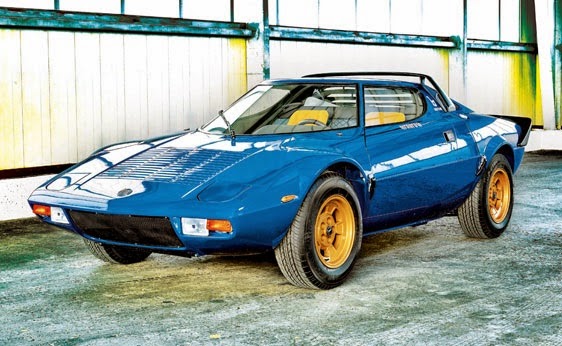
Lancia Stratos HF Stradale by Bertone 1974 - World Of Classic Cars -
![]() |
| Lancia Stratos HF Stradale by Bertone 1974 |
When launched, few cars turn the automobile world on its head. But if just one could be chosen which had just that effect, it would surely be the Lancia Stratos HF. It was the first automobile purposely built for competition in the World Rally Championship, and the Stratos’ powerful, radical design looked like nothing else on the road, ever. Further adding to the car’s lustre was the fact that it was probably the only Ferrari-powered car to be regularly seen in its element, covered in mud and sliding around the world’s toughest rally stages.
In 1970, Italian design house Bertone arrived at the Turin Motor Show with a radical concept, the Stratos Zero. It looked like a spaceship for the road and stood out not only to the throngs of media and show-goers but also to Lancia Director of Public Relations Sandro Fiorio. Fiorio turned to his son, Cesare, Lancia’s rally team chief, and the two pondered about how a production version of the Stratos could be introduced in order to reverse the manufacturer’s struggling motorsports division.
![]() |
| Lancia Stratos HF Stradale by Bertone 1974 |
With a sense of purpose, the Fiorios approached then Lancia Managing Director Ugo Gobbato with the idea of a Bertone-bodied car that was based on the Stratos Zero concept, albeit without the upward-swinging windscreen, which also doubled as a door. Gobbato signed-off on the project on the condition that it would be powered by a mid-mounted Ferrari V-6 engine and a five-speed manual gearbox, resulting in a clever example of corporate parts sharing.
A year later, the glowing orange Stratos HF (High Fidelity) prototype debuted at the 1971 Turin Auto Show. The Stratos’ stunning design was entrusted to Marcello Gandini, and in a nod to the car’s competition intentions, it featured a large wraparound front windshield, which offered an enormous outward view for its driver.
![]() |
| Lancia Stratos HF Stradale by Bertone 1974 |
The lightweight futuristic wedge-shaped design, along with its 192 horsepower, helped to propel the Stratos Stradale from 0 to 60 mph in less than five seconds, as well as to a top speed of 140 mph, which was certainly fast enough for any rally stage. It should come as no surprise that the Stratos was a huge success in the WRC, with three World Championship victories in 1974, 1975, and 1976. It would even go on to win rallies in 1979, which was several years after Lancia withdrew from rally competition.
The Stratos presented here was originally retained by Lancia S.p.A with the intention of transforming it into such a race car, although this ultimately didn’t happen. The car was sold to Lancia dealer Fratelli Beretta in northern Italy, and it remained under his care until the early 1990s. This HF Stradale was purchased by its current owner in its striking original pistachio green and trademark beige suede upholstery, and it has been used sparingly on a number of events. Currently, the Lancia remains largely unrestored and in a condition that one would expect of a car that has been cherished and enjoyed throughout its life.
marți, 29 martie 2016
Lancia Lambda 6th Series Torpedo Tourer 1926 - World Of Classic Cars -
![]() |
| Lancia Lambda 6th Series Torpedo Tourer 1926 |
From the very beginning, Vincenzo Lancia imbued his automobiles with a streak of technical forethought and motoring élan. His genius with the former was developed with hands-on work at the cycle and automobile factory of Giovanni Ceirano, the latter enriched during his time as a test driver at Fiat.
During the ’teens decade, Lancia developed his penchant for narrow-vee type engines, but it was the Lambda, launched in 1923, that took a giant step in the architecture of automobiles. With a monocoque chassis, Lancia combined an independent front suspension using a simple sliding pillar combined with coil springs. Lancia built slightly more than 11,000 Lambdas in nine separate series from 1923 to 1931 but just 1,300 6th Series examples in model years 1925 and 1926.
![]() |
| Lancia Lambda 6th Series Torpedo Tourer 1926 |
It is fortunate that the assembly details and records survive, which document that chassis number 14656 was ordered on January 15, 1926, and was assigned vehicle number 4664. The engine and rear axle match the numbers in the documentation, though the gearbox has been replaced by a unit identical to the original. Lancia’s internal records indicate that the bare monocoque chassis was completed and tested five days later; on Monday, January 25, the paintwork was completed. The following day, the vehicle was declared ready for delivery to its first owner.
![]() |
| Lancia Lambda 6th Series Torpedo Tourer 1926 |
Unfortunately, its subsequent owners and how it survived the war, in such an original and preserved state, remain mysteries lost in the mists of time. By the early 1980s, however, it had become well known and was observed by several club members. Later it served as a reference point for the restoration of several other Lambdas. That long-term family ownership ended in 1990. The next owner arranged for a formal inspection by the Automotoclub Storico Italiano on October 29, 1991. A Declaration of Technical Characteristics was issued by the ASI and remains with the vehicle.
![]() |
| Lancia Lambda 6th Series Torpedo Tourer 1926 |
In 2005, the Italian owner offered this Lancia for sale to various club members. It was sold in July 2007 to a private Japanese museum collection and formally imported and road-registered in Japan. More recently, it has been imported to the United States.
The older restoration has held up well. The body appears to have been repainted in the present blue, while the correct 20-inch black wire wheels and black tonneau cover provide nice contrast. The interior dates from the restoration and features the correct and beautiful original gauges, including a Jaeger MPH speedometer, clock, and Le Nivex fuel gauge.
joi, 24 martie 2016
Lancia Aurelia B24S Spider America by Pinin Farina 1955 - World Of Classic Cars -
![]() |
| Lancia Aurelia B24S Spider America by Pinin Farina 1955 |
Success to European automakers after World War II meant success in the United States, where American currency was free-flowing in the post-war boom economy. As a result, many automakers developed models attuned to U.S. tastes. Lancia’s entry was a proper two-seater open sports model of their modern Aurelia, featuring the world’s first production V-6 engine, with a balanced transaxle and inboard rear brakes. Known, appropriately, as the Spider America, the new model was built on a shortened chassis with beautiful Pinin Farina styling, including a dogleg wrap-around windshield, no external door or trunk handles, and utterly fluid lines that ranked among the most beautiful anywhere. Perhaps unsurprisingly, the model was destined to become the summer driver of choice for the la dolce vita set.
![]() |
| Lancia Aurelia B24S Spider America by Pinin Farina 1955 |
The Spider America was launched in 1954 and saw production of 240 copies over the next two years. Survivors are among the most hotly desired of all post-war European sports cars and often figure into important collections, such as that of renowned enthusiast Craig McCaw.
Mr. McCaw’s Spider America, chassis number B24S-1131, is one of 181 original left-hand-drive examples and has spent its entire life in the forgiving Western United States. In 1992, it was owned by the president of the U.S. Lancia Club, an avid vintage racer who had the car cosmetically restored by Italian Lancia expert Franco de Piero, while his full-time mechanic restored the car’s numbers-matching drivetrain. During the restoration, the original single Weber carburetor was replaced by a period-correct Nardi twin-carburetor conversion set-up, which, along with the Borrani center-lock wire wheels and the signature Nardi steering wheel, completes the highly desirable Nardi package.
![]() |
| Lancia Aurelia B24S Spider America by Pinin Farina 1955 |
Subsequently, the car became part of the respected Paul and Chris Andrews Collection of fine performance cars in Fort Worth, Texas, where it was well maintained and continued to be enjoyed until its acquisition for the McCaw stable several years ago.
As presented today, the car is finished in a rich and beautiful dark navy blue and remains in fine condition, a testimonial both to the quality of the car prior to the restoration and to the caliber of the restoration work itself. Only minor evidence of aging can be found upon close examination, as the restoration begins to mellow. The interior is very fresh, with only light wear to the seat cushions and a handsome embossed floor mat.
![]() |
| Lancia Aurelia B24S Spider America by Pinin Farina 1955 |
Under the hood is evidence of both the car’s originality and detailing; the engine bay is beautifully detailed but not over-restored, and the motor number, B24-1171, can still be found stamped into both cylinder heads. The underbody is undercoated and appears fresh, with minimal wear and soiling.
The Spider is accompanied by painstakingly restored removable side glasses, which can be easily stored in the trunk. The convertible top was replaced during the restoration; despite being a Fifties design, it is very simple to erect and seals nicely. When lowered, it disappears completely from view.
![]() |
| Lancia Aurelia B24S Spider America by Pinin Farina 1955 |
These stunning Spiders are highly prized by their intensely loyal owners, offering a nearly ideal combination of driving characteristics; they are fast, with delightfully nimble handling, quick and responsive steering, and undeniable grace and beauty. Their racing bloodlines and thoroughly sporting manner makes them not only eligible for but also ideal candidates to participate in virtually any important driving event worldwide.
luni, 14 martie 2016
Lancia Fulvia Sport S Series II by Zagato 1972 - World Of Classic Cars -
![]() |
| Lancia Fulvia Sport S Series II by Zagato 1972 |
Introduced to the public at the Geneva Motor Show in 1963, the Lancia Fulvia is best remembered for its distinguished racing history. The small Lancia had a string of rally successes in the '60's including winning the '72 International Rally Championship. Upon its release Road & Track magazine described the Fulvia as 'a precision motorcar, an engineering tour de force', and it enjoyed a well deserved sales success. Designed to replace the Lancia Appia and borrowing its engineering heavily from the Lancia Flavia, the Fulvia featured a newly designed narrow-angle V4 engine, independent suspension and all-round disc brakes. It was the narrow angle V4 engine though that really caused a storm. The DOHC design's narrow angle allowed for the use of a single cylinder head.
![]() |
| Lancia Fulvia Sport S Series II by Zagato 1972 |
The Lancia Fulvia was available in Berlina, Coupé, Rallye and Sport however it was the Coupé version that proved most popular and gained the racing accolades the Fulvia is credited with. Its handsome and distinctive lines, coupled with the famous narrow angle V4 engine have since contributed to its reputation as a modern classic. Equipped with five-speed gearbox and powered by the 90bhp 1.3-litre twin-overhead camshaft engine introduced for the Second Series HF model of 1970-76, it was a little jewel - with 100mph performance, light steering and excellent brakes. Outliving its saloon variant by three years, the last Coupé left Lancia's Chivasso plant in June 1976.
luni, 22 februarie 2016
Lancia Delta Integrale Evo I Martini 6 1992 - World Of Classic Cars -
![]() |
| Lancia Delta Integrale Evo I Martini 6 1992 |
In the 1990's, Lancia needed a replacement for their 2WD 037 world rally car which was being outclassed by the 4WD Audi Quattro. To remain competitive, Lancia inserted its own 4WD technology into the existing Delta platform to create the HF 4WD variant. This model initiated the continuous development of the incomparable and all-conquering HF Integrale which, from 1997 to 1992, claimed six consecutive World Rally Championships, a feat never yet surpassed. The HF 4WD evolved from the 8V Integrale to 16V Integrale, 16 EVO 1 to finally 16V EVO 2 with many production Stradale Special Editions of which the Martini 6 commemorates Lancia's 6th WRC win at the end of the 1992 season.
![]() |
| Lancia Delta Integrale Evo I Martini 6 1992 |
Set apart from the standard Delta Integrale, the Martini 6 was decorated in the iconic rally livery with stripes running down each side of the car and around the centre of the tailgate. Inside, the Recaro seats and interior trim were finished in a unique teal Alcantara with HF logos on the headrests. A large Lancia logo can be found on the rear of the roof and the rear-mounted spoiler is emblazoned with the famous 'Martini Racing' across it, replicating the rally-bred version. HF decals are applied high on each rear side panel and a 'World Rally Champion' badge adorns the tailgate along with the appropriate numeral '6' commemorating said number of championships. Inside, a carbon-fibre trim is fitted around the gear-lever and features a numbered plaque below it with the limited edition serial number.
luni, 8 februarie 2016
Lancia Delta HF 1988 - World Of Classic Cars -
![]() |
| Lancia Delta HF 1988 |
The Lancia Delta HF and Integrale dominated the world rallying scene in the late eighties and nineties winning 46 World Championship events and six consecutive manufactures titles. As a road car, the various evolutions of the model won many plaudits for their exceptional handling, wonderful steering, high performance and its awesome point-to-point abilities. Indeed, Car magazine recognised the Integrale as 'the greatest hot hatch' ever, likening its performance to that of a Porsche 911 and even testing it head-to-head with a Ferrari Testarossa. EVO magazine readers voted the Integrale in their top ten cars of all time, sitting comfortably alongside the McLaren F1 and Bugatti Veyron!
sâmbătă, 30 ianuarie 2016
Lancia Fulvia Competition 1972 - World Of Classic Cars -
![]() |
| Lancia Fulvia Competition 1972 |
The Lancia Fulvia was introduced at the Geneva Motor Show in 1963 and was produced all the way through to 1976. Fulvia's are notable for their role in motor racing history including winning the International Rally Championship in 1972. On testing it in 1967, Road and Track summed up the Fulvia as 'a precision motorcar, an engineering tour de force'. The Fulvia Berlina was designed by Antonio Fessia to replace the Lancia Appia with which it shared almost no components. The Appia was a rear wheel drive car; however, the Fulvia moved to front wheel drive like the Flavia. The general engineering design of the Fulvia was identical to that of the Flavia with the major exception of the engine; the Flavia having a four cylinder, horizontally opposed engine and the Fulvia a 'Narrow Angle' V configuration as featured on most production Lancias. The Fulvia used a longitudinal engine mounted in front of its transaxle. An independent suspension in front used wishbones and a single leaf spring, while a solid axle with a panhard rod and leaf springs was used in the rear. Four wheel Dunlop disc brakes were fitted to first series Fulvias.
duminică, 29 martie 2015
Lancia Aprilia - World Of Classic Cars -
![]() |
| Lancia Aprilia 1938 |
Produced between 1937 and 1949 the Lancia Aprilia was years ahead of its time. The first series was produced between 1937 and 1939 featuring a 1352cc engine with the second series being produced between 1939 and 1949 with an increased engine size of 1486cc. Also offered were the Lusso and Lungo models based upon the second series Aprilia. Designed in a wind tunnel, the all monocoque construction demonstrated a record low drag coefficient of only 0.47. This was one of Vincenzo Lancia's last designs as he sadly passed away only one month prior to commencement of production in February 1937. The specification included four pillarless doors, independent suspension all around, hydraulic brakes, sliding pillar front suspension and trailing arm rear suspension with a transverse leaf spring. Power was by the jewel-like 1352cc, V4 engine that featured hemispherical combustion chambers, duralumin conrods and an aluminium cylinder block. The mix of good aerodynamic and engine design produced a motorcar that could seat up to five in comfort and also provided excellent speed and economy for the period.
sâmbătă, 28 martie 2015
Lancia Delta - World Of Classic Cars -
![]() |
| Lancia Delta Integrale Evolution 1 1992 |
The Lancia Delta was first shown in Frankfurt Motor Show in 1979. The Delta is best known for its World Rally Championship career in the late 1980s and early 1990s, when it dominated. The first Evoluzione cars were built at the end of 1991 and through 1992. These were to be the final homologation cars for the Lancia Rally Team; the Catalytic Evoluzione II was never rallied by the factory. In order to improve the handling, the Evoluzione had a wider track front and rear than earlier Deltas. In order to enclose this track in the bodywork, the wide arches were extended even further and in the process also became more rounded. The front strut top mounts were also raised in height in the quest for more grip: this then necessitated a front strut brace to control the forces thus generated. External changes included: new grilles in the front bumper to improve the air intake for engine compartment; a redesigned bonnet with new lateral air slats to further assist under bonnet ventilation; an adjustable roof spoiler above the tailgate to assist in competition; new five-bolt wheels derived from the rally cars; and finally, the rear of the car was changed with only one exhaust pipe now showing. The new Integrale retained the four wheel drive layout: an epicyclic centre diff with torque splitter, Ferguson viscous coupling and Torsen rear differential. The engine, although technically the same as the earlier 16V cars, was remapped to give 210bhp at 5750rpm in order to compensate for the slight increase in weight and increased frontal area. This kept the performance figures virtually unchanged. These improvements were aimed at, and did change, the cars' handling potential, with the new car being able to travel 5% faster over rally sections both tarmac and gravel. The result was even greater driver confidence when driving in normal road conditions.
marți, 6 ianuarie 2015
Lancia Beta 2000 Spider - World Of Classic Cars -
![]() |
| Lancia Beta 2000 Spider by Zagato 1980 Bun |
The Lancia Beta range consisted of a four- door saloon, three-door sports estate (HPE), the mid-engine Monte Carlo Coupé and the 2+2 Spider, the latter styled by Pininfarina but built by Zagato. Only 9,390 Spiders were built before production ended in 1984 and at this time just 14 of the righthand drive, two litre models were registered in the UK at the beginning of this year. The chassis, suspension and interior were very definitely the work of the Lancia engineers and possess all the qualities one would expect from this revered marque. The independent rear suspension was particularly ingenious and widely copied by other manufacturers as FIAT neglected to patent the design. To call these Beta Spiders rare is an understatement yet spare parts are easy to come by and they are huge fun to drive with superb handling and a decent turn of speed.
duminică, 2 noiembrie 2014
Lancia Aurelia PF200 C Spider by Pinin Farina 1953 - World Of Classic Cars -
PININ FARINA EXPLORES THE JET AGE
By the early 1950s, as Pinin Farina’s reputation began to soar on the success of the Cisitalia 202, the company became an increasingly popular destination for well-heeled customers to body the sporting chassis of their choice. In addition to customer-based orders such as these, Pinin Farina (like most carrozziere) indulged in styling exercises that were used for promotional purposes at auto shows and the day’s finer European concours d’elegance.
At the Turin Motor Show in the spring of 1952, Pinin Farina debuted a new concept car built on a Lancia B52 Aurelia chassis alongside their freshly redesigned Nash-Healey. The B52 chassis is notable in that only 98 examples were constructed, and all were sent to bespoke coachbuilders for one-off or limited-run production. Pinin Farina’s new Aurelia was abundant with Jet Age styling cues and featured a protruding circular nose with a large chromed bezel, reminiscent of the intake of an F-86 Sabre fighter plane. A raked windshield, pontoon-style fenders, and uninterrupted beltlines led to a finned tail that had six individual exhaust tips emerging immediately above the rear bumper.
This unique roadster was dubbed the PF200 and was the first of a short run of similarly styled cars that Pinin Farina built over the next four years, which all featured the signature gaping nose and general proportions of the first Turin car. This run principally consisted of two more open-top cars and three to four coupes.
Each PF200 varied slightly from the last, with only the prototype featuring the circular nose. Succeeding versions were constructed with more elliptic noses, while some had standard tailpipes, and others featured the bumper-through exhausts of the original Turin car. Even the three open cars varied from one another, as one had a removable top and side curtains (in true spider fashion) and the others featured wind-up windows and a more permanent soft-top.
The PF200’s styling did not go unnoticed by the public, and it spurred the build of at least two more similarly styled cars on American chassis. Jazz impresario Norman Granz saw the prototype PF200 Roadster at Turin in 1952 and ordered similar bodywork on a Cadillac 62 chassis, while Pinin Farina took their design a step further with the Palm Beach Special of 1956, which was built on a Nash Rambler chassis.
With a fire at the Pininfarina factory reportedly destroying a fair amount of documentation, including the individual records of the PF200 examples, definitive original sources regarding the model are scant, but it is believed that no more than a total of eight cars were produced, with perhaps just over half of those surviving today.
CHASSIS B52-1052: THE PF200 C
Chassis B52-1052 is the second of what is believed to be three open-top examples of the PF200. It debuted at the Geneva Salon in March 1953, nearly a year after the prototype’s introduction at Turin. The so-called PF200 C was slightly more ornate than its predecessor, as it had chrome hashes behind the doors and featured an oval nose that was not yet chromed (copying that of the first PF200 Coupe, shown at Paris the previous fall). This newer roadster also featured front bumperettes that were directly underneath the headlamps, rather than in the inboard bumper arrangement of the prototype. It is the only car of the entire run to feature a nose badge that reads “pf200 C,” prompting speculation that this car was conceptually positioned as a competizione version of the style. It was equipped with a two-position windscreen and omitted wind-up windows, for a more sporting appeal.
The PF200 concept appeared the following month at the 1953 Turin Motor Show. As with the other PF200 examples, this Aurelia was constantly being updated by Pinin Farina, as evidenced by minor changes from appearance to appearance, including sometimes being finished in different colors. Following its appearance at Turin, B52-1052 was next photographed at the Stresa International Concours d’Elegance in September 1953, where the car won a Grand Prize Honor. A placard commemorating this win was mounted to the dashboard, and this original distinction continues to grace the car today.
As photos of the car at Stresa reveal, by September 1953, the Lancia had been equipped with a full windshield frame, complete with a top edge, as well as wind-wings and a hood deflector (à la competition cars). The presence of Milan license plates reading MI 215522 suggests that this Spider had been purchased and registered by a private owner at this point.
By the 1960s, chassis B52-1052 was imported to the United States, and following ownership by a California-based enthusiast, the car was acquired by a friend of the consignor, a Michigan-based automotive engineer, who bought the car in 1968. The PR200 C was in strong overall condition at the time of this purchase, and it remained in this ownership for over the next 30 years, eventually following the consignor to Florida when he moved there in 1996.
After becoming acquaintances with restoration specialist Tom Palisi, of Tarpon Springs, Florida, whose father was a significant figure in the local Jaguar community, the consignor considered the prospect of a full restoration to this unique PF200 C.
Mr. Palisi meticulously disassembled and bagged all of the parts. The body was acid-dipped and minor corrosion areas were removed and re-fabricated, after which Mr. Palisi treated the exterior to a deep finish in maroon paint. The front axle and the transaxle were sent for a rebuild to Luciano Sanzogni, of Sarasota, Florida, a former Lancia apprentice with years of experience specializing in Italian sports cars. The brakes, suspension, and wiring harness were each properly rebuilt.
Several highly regarded authorities in the American Lancia community were consulted during the restoration, including Mike Kristick and the late Walt Spak, both of whom were instrumental in sourcing numerous correct parts. As the original motor was beyond recovery, Mr. Spak hunted for an authentic Aurelia engine and was fortunate enough to locate the block from the PF200 Coupe that had been owned by well-known importer Kjell Qvale, of San Francisco, California.
Mr. Spak saw to a complete rebuild of the replacement engine, which included the installation of many new parts, such as pistons, rings, sleeves, and other such components.
This work included sourcing the proper shorter carburetors and unique offset air filter, both of which were mandatory acquisitions for the concept car’s hood to properly close, as the original Aurelia engine was not designed to be used in such a diminutive compartment!
As this Aurelia is a one-off concept car, many of the trim pieces were essentially irreplaceable items that could not be sourced. Accordingly, Mr. Palisi hired a local aviation machinist who specialized in such challenges to fabricate numerous pieces. He also ensured that the unique exhaust setup, which had been blocked off at the time of the consignor’s 1968 purchase, was properly routed to newly chromed pipes. The windscreen, top, and curtains were all carefully rebuilt using components from the originals, and all of the frame pieces were beautifully chromed. The interior was reupholstered by Rudy Bailey, of Tampa, Florida, who also sourced authentic NOS Pirelli diamond-pattern trunk mats, and a correct Autovox radio was rebuilt from two original units that were sourced.
The exacting restoration, taking roughly 10 years to complete, was finished in early 2013 and no expense was spared. This stunning PF200 C was presented at the Concours d’Elegance of America at St. Johns in June 2013, where it won First in Class and The Art that Moves Us Award, and the following March, the car took home another class award from the 2014 Amelia Island Concours d’Elegance.
![]() |
| Lancia Aurelia PF200 C Spider by Pinin Farina 1953 |
By the early 1950s, as Pinin Farina’s reputation began to soar on the success of the Cisitalia 202, the company became an increasingly popular destination for well-heeled customers to body the sporting chassis of their choice. In addition to customer-based orders such as these, Pinin Farina (like most carrozziere) indulged in styling exercises that were used for promotional purposes at auto shows and the day’s finer European concours d’elegance.
At the Turin Motor Show in the spring of 1952, Pinin Farina debuted a new concept car built on a Lancia B52 Aurelia chassis alongside their freshly redesigned Nash-Healey. The B52 chassis is notable in that only 98 examples were constructed, and all were sent to bespoke coachbuilders for one-off or limited-run production. Pinin Farina’s new Aurelia was abundant with Jet Age styling cues and featured a protruding circular nose with a large chromed bezel, reminiscent of the intake of an F-86 Sabre fighter plane. A raked windshield, pontoon-style fenders, and uninterrupted beltlines led to a finned tail that had six individual exhaust tips emerging immediately above the rear bumper.
![]() |
| Lancia Aurelia PF200 C Spider by Pinin Farina 1953 |
This unique roadster was dubbed the PF200 and was the first of a short run of similarly styled cars that Pinin Farina built over the next four years, which all featured the signature gaping nose and general proportions of the first Turin car. This run principally consisted of two more open-top cars and three to four coupes.
Each PF200 varied slightly from the last, with only the prototype featuring the circular nose. Succeeding versions were constructed with more elliptic noses, while some had standard tailpipes, and others featured the bumper-through exhausts of the original Turin car. Even the three open cars varied from one another, as one had a removable top and side curtains (in true spider fashion) and the others featured wind-up windows and a more permanent soft-top.
![]() |
| Lancia Aurelia PF200 C Spider by Pinin Farina 1953 |
The PF200’s styling did not go unnoticed by the public, and it spurred the build of at least two more similarly styled cars on American chassis. Jazz impresario Norman Granz saw the prototype PF200 Roadster at Turin in 1952 and ordered similar bodywork on a Cadillac 62 chassis, while Pinin Farina took their design a step further with the Palm Beach Special of 1956, which was built on a Nash Rambler chassis.
With a fire at the Pininfarina factory reportedly destroying a fair amount of documentation, including the individual records of the PF200 examples, definitive original sources regarding the model are scant, but it is believed that no more than a total of eight cars were produced, with perhaps just over half of those surviving today.
CHASSIS B52-1052: THE PF200 C
![]() |
| Lancia Aurelia PF200 C Spider by Pinin Farina 1953 |
Chassis B52-1052 is the second of what is believed to be three open-top examples of the PF200. It debuted at the Geneva Salon in March 1953, nearly a year after the prototype’s introduction at Turin. The so-called PF200 C was slightly more ornate than its predecessor, as it had chrome hashes behind the doors and featured an oval nose that was not yet chromed (copying that of the first PF200 Coupe, shown at Paris the previous fall). This newer roadster also featured front bumperettes that were directly underneath the headlamps, rather than in the inboard bumper arrangement of the prototype. It is the only car of the entire run to feature a nose badge that reads “pf200 C,” prompting speculation that this car was conceptually positioned as a competizione version of the style. It was equipped with a two-position windscreen and omitted wind-up windows, for a more sporting appeal.
![]() |
| Lancia Aurelia PF200 C Spider by Pinin Farina 1953 |
The PF200 concept appeared the following month at the 1953 Turin Motor Show. As with the other PF200 examples, this Aurelia was constantly being updated by Pinin Farina, as evidenced by minor changes from appearance to appearance, including sometimes being finished in different colors. Following its appearance at Turin, B52-1052 was next photographed at the Stresa International Concours d’Elegance in September 1953, where the car won a Grand Prize Honor. A placard commemorating this win was mounted to the dashboard, and this original distinction continues to grace the car today.
![]() |
| Lancia Aurelia PF200 C Spider by Pinin Farina 1953 |
As photos of the car at Stresa reveal, by September 1953, the Lancia had been equipped with a full windshield frame, complete with a top edge, as well as wind-wings and a hood deflector (à la competition cars). The presence of Milan license plates reading MI 215522 suggests that this Spider had been purchased and registered by a private owner at this point.
By the 1960s, chassis B52-1052 was imported to the United States, and following ownership by a California-based enthusiast, the car was acquired by a friend of the consignor, a Michigan-based automotive engineer, who bought the car in 1968. The PR200 C was in strong overall condition at the time of this purchase, and it remained in this ownership for over the next 30 years, eventually following the consignor to Florida when he moved there in 1996.
![]() |
| Lancia Aurelia PF200 C Spider by Pinin Farina 1953 |
After becoming acquaintances with restoration specialist Tom Palisi, of Tarpon Springs, Florida, whose father was a significant figure in the local Jaguar community, the consignor considered the prospect of a full restoration to this unique PF200 C.
Mr. Palisi meticulously disassembled and bagged all of the parts. The body was acid-dipped and minor corrosion areas were removed and re-fabricated, after which Mr. Palisi treated the exterior to a deep finish in maroon paint. The front axle and the transaxle were sent for a rebuild to Luciano Sanzogni, of Sarasota, Florida, a former Lancia apprentice with years of experience specializing in Italian sports cars. The brakes, suspension, and wiring harness were each properly rebuilt.
![]() |
| Lancia Aurelia PF200 C Spider by Pinin Farina 1953 |
Several highly regarded authorities in the American Lancia community were consulted during the restoration, including Mike Kristick and the late Walt Spak, both of whom were instrumental in sourcing numerous correct parts. As the original motor was beyond recovery, Mr. Spak hunted for an authentic Aurelia engine and was fortunate enough to locate the block from the PF200 Coupe that had been owned by well-known importer Kjell Qvale, of San Francisco, California.
Mr. Spak saw to a complete rebuild of the replacement engine, which included the installation of many new parts, such as pistons, rings, sleeves, and other such components.
![]() |
| Lancia Aurelia PF200 C Spider by Pinin Farina 1953 |
This work included sourcing the proper shorter carburetors and unique offset air filter, both of which were mandatory acquisitions for the concept car’s hood to properly close, as the original Aurelia engine was not designed to be used in such a diminutive compartment!
As this Aurelia is a one-off concept car, many of the trim pieces were essentially irreplaceable items that could not be sourced. Accordingly, Mr. Palisi hired a local aviation machinist who specialized in such challenges to fabricate numerous pieces. He also ensured that the unique exhaust setup, which had been blocked off at the time of the consignor’s 1968 purchase, was properly routed to newly chromed pipes. The windscreen, top, and curtains were all carefully rebuilt using components from the originals, and all of the frame pieces were beautifully chromed. The interior was reupholstered by Rudy Bailey, of Tampa, Florida, who also sourced authentic NOS Pirelli diamond-pattern trunk mats, and a correct Autovox radio was rebuilt from two original units that were sourced.
![]() |
| Lancia Aurelia PF200 C Spider by Pinin Farina 1953 |
The exacting restoration, taking roughly 10 years to complete, was finished in early 2013 and no expense was spared. This stunning PF200 C was presented at the Concours d’Elegance of America at St. Johns in June 2013, where it won First in Class and The Art that Moves Us Award, and the following March, the car took home another class award from the 2014 Amelia Island Concours d’Elegance.
duminică, 26 octombrie 2014
Lancia Stratos - World Of Classic Cars - Rank 178
![]() |
| Lancia Stratos 'Stradale' 1976 |
The Lancia Stratos HF (Tipo 829), widely and more simply known as Lancia Stratos, is a car made by Italian car manufacturer Lancia. The HF stands for High Fidelity. It was a very successful rally car, winning the World Rally Championship in 1974, 1975 and 1976.
A Bertone-designed concept car called the Lancia Stratos Zero was shown to the public in 1970, but shares little but the name and mid-engined layout with the Stratos HF version. A new car called the New Stratos was announced in 2010 which was heavily influenced by the design of the original Stratos, but was based on a Ferrari chassis and engine.
History
![]() |
| Lancia Stratos H.F. 1972 |
Bertone had previously done no business with Lancia, who were traditionally linked with Pininfarina, and he wanted to come into conversation with them. Bertone knew that Lancia was looking for a replacement for the ageing Fulvia for use in rally sports and so he designed an eyecatcher to show to Lancia. Bertone used the running gear of the Fulvia Coupé of one of his personal friends and built a running showpiece around it. When Bertone himself appeared at the Lancia factory gates with the Stratos Zero he passed underneath the barrier and got great applause from the Lancia workers.
![]() |
| Lancia Stratos HF Stradale 1974 |
After that a cooperation between Lancia and Bertone was decided to develop a new rally car based on ideas of Bertone’s designer Marcello Gandini who already had designed the Lamborghini Miura and Countach.
Lancia presented the Bertone-designed Lancia Stratos HF prototype at the 1971 Turin Motor Show, a year after the announcement of the Stratos Zero concept car. The prototype Stratos HF (Chassis 1240) was fluorescent red in colour and featured a distinctive crescent-shaped-wrap-around windshield providing maximum forward visibility with almost no rear visibility. The prototype had three different engines in its early development life: the Lancia Fulvia engine, the Lancia Beta engine and finally for the 1971 public announcement, the mid-mounted Dino Ferrari V6 producing 192 PS (141 kW). The use of the Dino V6 was planned right from the beginning of the project, but Enzo Ferrari was reluctant to sign off the use of this engine in a car he saw as a competitor to his own Dino V6. After long and very Italian political antics and after the production of the Dino car had ended the Commendatore agreed on delivering the engines for the Stratos and all of a sudden 500 engines were dumped on Lancia’s door.
![]() |
| Lancia Stratos HF Stradale 1975 |
The Stratos was a very successful rally car during the 1970s and early 1980s. It started a new era in rallying as it was the first car designed from scratch for this kind of competition. The three leading men behind the entire rallying project were Lancia team manager Cesare Fiorio, British racer/engineer Mike Parkes and factory rally driver Sandro Munari with Bertone's Designer Marcello Gandini taking a very personal interest in designing and productionising the bodywork.
Lancia did extensive testing with the Stratos and raced the car in several racing events where Group 5 prototypes were allowed during the 1972 and 1973 seasons. Production of the 500 cars required for homologation in Group 4 commenced in 1973 and the Stratos was homologated for the 1974 World Rally Championship season. The Ferrari Dino V6 engine was phased out in 1974, but 500 engines among the last built were delivered to Lancia. Production ended in 1975 when it was thought that only 492 were made (for 1976 season, the Group 4 production requirement was reduced to 400 in 24 months).
![]() |
| Lancia Stratos 'Stradale' 1973 |
Manufacturer of the car was Bertone in Turin, with final assembly by Lancia at the Chivasso plant. Powered by the Dino 2.4 L V6 engine that was also fitted to the rallying versions, but in a lower state of tune, it resulted in a power output of 190 PS (140 kW), giving the road car a 0-60 mph time of just under five seconds, and a top speed of 144 mph (232 km/h). The car was sold as the Lancia Stratos Stradale.
For racing, the engine was tuned up to 275 PS (202 kW) for the 12v version, 320 PS (235 kW) for the later 24v version and even to 560 PS (412 kW) with a single KKK turbocharger. However, turbocharged versions were only allowed to compete in Group 5 and were never as reliable as their naturally aspirated counterparts.
![]() |
| Lancia Stratos HF Zero 1970 |
The car won the 1974, 1975 and 1976 championship titles in the hands of Sandro Munari and Björn Waldegård, and might have gone on to win more had not internal politics within the Fiat group placed rallying responsibility on the Fiat 131 Abarths. As well as victories on the 1975, 1976 and 1977 Monte Carlo Rally, all courtesy of Munari, the Stratos won the event with the private Chardonnet Team as late as 1979. The Stratos won the 1974 Targa Florio.
Without support from Fiat, and despite new regulations that restricted engine power, the car would remain a serious competitor and proved able to beat works cars in several occasions when entered by an experienced private team with a talented driver. The last victory of the Stratos was in 1981, at the Tour de Corse Automobile, another World Rally Championship event, with a victory by longtime Stratos privateer Bernard Darniche.
![]() |
| Lancia Stratos HF Stradale 1974 |
When the Fiat group favoured the Fiat 131 for rallying Lancia also built two Group 5 turbocharged 'silhouette' Stratos for closed-track endurance racing. These cars failed against the Porsche 935s on closed tracks but proved successful in hybrid events. While they failed in the Tour de France Automobile, one of these cars won the 1976 Giro d'Italia Automobilistico, an Italian counterpart of the Tour de France Automobile. Unfortunately one of the cars was destroyed in Zeltweg, when it caught fire due to overheating problems. The last surviving car would win the Giro d'Italia event again before it was shipped to Japan to compete in the Fuji Speedway based Formula Silhouette series, which was never raced. The car would then be sold and reside in the Matsuda Collection before then being sold to the renowned collector of Stratos', Christian Hrabalek, a car designer and the founder of Fenomenon Ltd, who has the largest Lancia Stratos Collection in the world, 11 unique Lancia Stratos cars, including the fluorescent red 1971 factory prototype and the 1977 Safari Rally car. His interest in the car led to the development of the Fenomenon Stratos in 2005. The Stratos also gained limited success in 24 Hours of Le Mans, with a car, driven by Christine Dacremont and Lella Lombardi, finishing 20th in 1976.
![]() |
| Lancia Stratos HF Stradale 1975 |
Another unique Group 5 car is the Lancia Stratos HF of Austrian Rallycross driver Andy Bentza. The car was first driven by his Memphis team mate Franz Wurz, father of Formula One pilot Alexander Wurz. In 1976 Wurz claimed the first ever European Rallycross title recognised by the FIA with the car, by then still featuring a 2.4 litre engine with 12 valve head. For the ERC series of 1977 Wurz was entrusted with an experimental 24 valve engine by Mike Parkes, equipped with a special crankshaft to bring the engine capacity up to just under 3000 cc. For 1978 Bentza took the Stratos over from Wurz, sold his own 2.4 L 12V Stratos to compatriot Reneé Vontsina, and won the GT Division title of the ERC. The one and only 3.0 litre Stratos was raced by Bentza till the end of 1983. After keeping the car for another 30 years the car has recently been sold to a new Austrian owner.
Abonați-vă la:
Postări (Atom)


