Se afișează postările cu eticheta Chrysler. Afișați toate postările

vineri, 29 aprilie 2016

Chrysler C-300 Coupe 1955 - World Of Classic Cars -

Chrysler C-300 Coupe 1955

Chrysler’s new C-300 model for 1955 was nothing less than a sensation. It was based on the New Yorker Hardtop Coupe and had the front sheet metal and grille from the Imperial, which was now a separate make. Power came from the mightiest engine in the company catalogue, a 331-cubic inch hemi V-8 with dual four-barrel carburetors, a racing cam, and solid lifters. At 300 brake horsepower—hence its name—it was the most powerful American passenger car.
Tom McCahill, the colorful pioneer auto critic, loved it. A “hairy-chested Chrysler,” he called it in Mechanix Illustrated, “definitely not the car for Henrietta Plushbottom, your maiden schoolmarm aunt, to use for hustling up popsicles for the kiddies.” It was, he said, a “hard-boiled magnificent piece of semi-competition transportation, built for the real automotive connoisseur. As solid as Grant’s Tomb, and 130 times as fast.” Actually, “semi-competition” underplayed its importance.
Chrysler C-300 Coupe 1955

Outboard motor magnate Carl Kiekhaefer readied a team of C-300s for the 1955 stock car season and won both the NASCAR Grand National Championship and the AAA Stock Car Championship.
This 1955 Chrysler C-300 Hardtop Coupe is a gorgeous example finished in white over a tan leather interior. It has chrome wire wheels, wide whitewall tires, power windows, power steering, power brakes, a radio, a heater, and a dash clock. Originally purchased in Missouri, it later made its way to the dry climate of New Mexico, where it remained until 2004. It then received a high-quality body-on restoration that included a rebuilt engine, carburetors, transmission, starter, generator, master cylinder, and brakes, as well as new paint, upholstery, and dual exhaust.
Chrysler C-300 Coupe 1955

It is pure and simple in white with tan upholstery and a stunning reminder of what took the public by surprise in 1955. The exterior is understated, by the morays of the day when two-tone schemes in bright colors were the norm. Reportedly, an outside rear-view mirror was not offered, even as an accessory, because the designers felt it would spoil the lines. This car, correctly, has no such distraction.

duminică, 24 aprilie 2016

Chrysler Windsor 'Highlander' Convertible 1941 - World Of Classic Cars -

Chrysler Windsor 'Highlander' Convertible 1941

Chrysler offered its entry-level, six-cylinder Series 28 in a wide variety of body styles for the 1941 model year, divided up into three trim levels: the Royal, the Windsor, and the Windsor Highlander. The Windsor Highlander was the most expensive and prestigious of these models, especially in convertible form, and was distinguished by a standard solid leather interior with inserts of tartan plaid. It was part of a trend toward unusual interior fabrics and materials in Chryslers of this era, which also saw additional optional packages based upon, among other things, Navajo blankets.
Chrysler Windsor 'Highlander' Convertible 1941

The Windsor Highlander Convertible presented here was the recipient of an excellent, high-quality professional restoration in the early 1990s, after which it eventually reached Senior Grand National First Prize status in 1998. The car was formerly owned by respected Ontario enthusiast Jim Miller and has been well maintained within Mr. Weaver’s collection. Today it remains in like-new condition, with hardly any wear or aging present, and showed about 493 miles at the time of cataloguing. Panel fit throughout is excellent, as is the period-correct maroon finish and the proper Highlander interior, with its correct modeled plastic dashboard and door trim. The engine, firewall, and chassis show only minimal signs of usage.

Chrysler Royal Town and Country Station Wagon 1950 - World Of Classic Cars -

Chrysler Royal Town and Country Station Wagon 1950

Chrysler had emerged from the immediate post-war era as a true powerhouse of upscale American automobile manufacturing by 1950. The Chrysler model line was diverse and well engineered, and, most of all, it challenged the competition to create cars that could compete on equal terms with the new Chryslers. The marque offered, as its advertising copy proclaimed, “America’s Finest for 1950,” and its models included the Royal, Windsor, Saratoga, and New Yorker, as well as the Town and Country, which remained the top-of-the-line model. However, the Town and Country was slowly being phased out to allow Chrysler to place greater emphasis on its other cars.
Chrysler Royal Town and Country Station Wagon 1950

Generally speaking, the differences between Chrysler models at this time amounted to different engines, wheelbase lengths, or trim levels. The Royal Town and Country Station Wagon was a car that bridged the gap for Chrysler as the Town and Country’s popularity waned. In fact, 1950 was the last model year that Chrysler offered a true wood-bodied car, with 599 of this style produced. Consequently, few 1950 Chrysler Royal Town and Countries survive today, and fewer still are as attractive as the example presented here.
The Pagoda Cream car is very attractive throughout and continues to benefit from a nice older restoration. The exterior finish is accented by extensive brightwork, a driver’s side spotlight, period-style wide whitewall tires, and painted steel wheels with bright trim rings and hubcaps, as well as eye-catching and beautifully finished woodwork. The interior is trimmed in correct alligator-patterned upholstery complemented by recently restored interior woodwork, while the trademark Chrysler steering wheel, dash, instruments, and controls are complete and correct. The engine bay is well detailed in its overall appearance as well, with the minor exception of a modern battery and hose clamps.

Chrysler CG Imperial Dual-Cowl Phaeton in the style of LeBaron 1931 - World Of Classic Cars -

Chrysler CG Imperial Dual-Cowl Phaeton in the style of LeBaron 1931

Chrysler’s Imperial had grown from simply an upmarket version of lesser models into something truly unique and special by 1931. It had been graced with classically beautiful styling, which was inspired by the Cord L-29, and was noteworthy for its massive 145-inch-wheelbase chassis and smooth 125-horsepower straight eight. This car was not only big and powerful but also a superb driver with advanced steering geometry that made it shockingly easy to swing through wide corners at speed. The term “driver’s car” is seldom applied to American Classics of this era, but it is apt for the Imperial.
Chrysler CG Imperial Dual-Cowl Phaeton in the style of LeBaron 1931

Drivers with funds to spare could opt for “semi-custom” bodywork that had been supplied by the LeBaron imprint of Briggs and styled by Ralph Roberts. With aviation in the forefront of American culture, the open LeBaron custom body styles adopted aircraft-like leather interiors that wrapped around the cowl and over the doors. Riding in one of the 85 dual-cowl phaetons built in 1931 was like coasting along the ground in one’s own biplane.
The car presented here, serial number 7801805, was restored in the 1980s with a well-crafted dual-cowl phaeton body in the style of a LeBaron original and carrying a reproduction body tag of 147-32.
Chrysler CG Imperial Dual-Cowl Phaeton in the style of LeBaron 1931

The front fenders are original, but it appears that the rear fenders were reproduced or modified as needed to fit the new coachwork. The restoration has held up well over the years and continues to show good panel fit throughout, with fine red paint showing few signs of use. The older brown leather interior, tan canvas top, and reproduction dashboard gauges show some signs of driving enjoyment. Period chrome wire wheels are fitted, along with dual side-mounts with cloth covers and mirrors, dual trumpet horns, tail lamps, wind wings, a radiator stone guard, a rear luggage track, a trunk, and the classic Gazelle radiator mascot.
Chrysler CG Imperial Dual-Cowl Phaeton in the style of LeBaron 1931

Underneath, the chassis is complete and well detailed and features many of the regularly overlooked or missing items, including correct grease fittings, metal spring gaiters, and correct hydraulic lines. The engine is fitted with the correct Delco-Remy ignition system and Stromberg downdraft carburetor.

sâmbătă, 23 aprilie 2016

Chrysler Windsor Convertible Coupe 1940 - World Of Classic Cars -

Chrysler Windsor Convertible Coupe 1940

All Chrysler cars were redesigned for 1940. A horizontal, thin-bar grille gave a new look, and re-contoured fenders had sealed-beam headlights, a new industry feature, integrated into their leading edge.
Six-cylinder cars were designated C-25 and came in two series: Royal, the entry-level line, and Windsor, which had better appointments. The convertible coupe, reintroduced after a one-year absence, was available only in the Windsor line. The 241.5-cubic inch L-head inline six-cylinder Gold Seal engine had been carried over from 1939, but it was given a modest power increase. Chrysler’s Fluid Drive, which had debuted in 1939, was available on eight-cylinder cars. All C-25 sixes had a conventional dry clutch and three-speed manual gearbox, but an overdrive was optional, though rarely ordered.
Chrysler Windsor Convertible Coupe 1940

The condition of this 1940 Windsor Convertible Coupe belies the age of its restoration. Completed in 1996, it went on to Antique Automobile Club of America National First and Senior honors. It won Best of Show at a national Chrysler club event, and it remains concours-worthy today.
The car is finished in burgundy with a contrasting tan Haartz cloth top and has matching burgundy leather throughout. The top is power-operated, the first year this feature was available. The Windsor has Chrysler’s other noteworthy 1940 features, including a Safety Signal Speedometer, which changes color with increasing speed, front-door wind wings, unique to convertibles, and the optional hidden running boards. It has authentic bumper over-riders, a Chrysler windshield post spotlight, dual fog lights, and accessory directional signals, the latter integrated into front and rear lights. It also has the coveted but very rare overdrive transmission. Unusually, there is no radio, and in its place is a correct radio-delete plate in the dashboard. Nor is there a heater, implying it was originally sold in California or a similar warm climate. Wide whitewall tires nicely complement body-color steel wheels with correct red-line hubcaps and bright beauty rings, and the bumpers have accessory over-riders. The rear fenders have attractive skirts, an authentic Chrysler accessory.
Chrysler built just 2,275 Windsor Convertible Coupes for 1940, the lowest production of any body style except the long-wheelbase sedans and limousines.

vineri, 25 martie 2016

Chrysler Town and Country Convertible 1947 - World Of Classic Cars -

Chrysler Town and Country Convertible 1947

The Chrysler Town and Country was introduced in 1941, but it was originally conceived in 1939 by Dave Wallace, who envisioned a wood-bodied car with the same basic lines as Chrysler’s steel-bodied models yet also had greater refinement, quality, panache, and a level of artistry that recalled a bygone era. In fact, its ash- and mahogany-framed body, which was hand-built with techniques more closely associated with fine wooden boat construction, projected an image of affluence and leisure that increased traffic at Chrysler dealerships nationwide.
For 1946, the convertible coupe variant was introduced, replacing the more utilitarian four-door station wagon. Heightened public interest in the new Chrysler model, enticed by a two-page spread in the widely read Saturday Evening Post, prevented the firm from making clay models or prototypes. As a result, the car was reportedly built just from sketches to meet looming production schedules.
Chrysler Town and Country Convertible 1947

Cosmetically, very little changed between 1946 and 1948, but plans were laid for the launch of the 1949 Chrysler models. The Town and Country Convertible was based on the upscale New Yorker series, yet it offered a wide variety of luxurious appointments in addition to the New Yorker’s many standard features. With a starting price of $3,420, the Town and Country Convertible was the most expensive Chrysler model available.
The 1947 model shown here was restored for its previous owner by the noted firm of Al Prueitt & Sons in Glen Rock, Pennsylvania, from what is said to be a solid and excellent original car. The workmanship throughout is impressive and meticulous, including absolutely incredible correct woodwork, a beautiful finish in the proper factory color of Panama Sand, and superb fit and finish throughout, with excellent panel gaps and glistening chrome. The car even has numerous desirable options and accessories such as a power-operated convertible top, fog lights, a driver’s side spotlight, an AM radio, an exhaust extension, and a center bumper guard.

vineri, 26 februarie 2016

Chrysler Series 75 Roadster 1929 - World Of Classic Cars -

Chrysler Series 75 Roadster 1929

Chrysler automobiles of the late 1920s were not merely well engineered and solidly constructed, they were also remarkably fast. Between 1925 and 1931, Chryslers competed internationally at such events as the Mille Miglia and the 24-hour races at Le Mans and Spa, running against the best and most expensive automobiles that Europe had to offer. In fact, at the 1929 running of Le Mans, a Series 75 Roadster finished 6th overall and 3rd in the Index of Performance (Stoffel/Benoist). At the 1929 24 Hours of Spa, two cars finished 6th (Stoffel/Rossignol) and 11th (Hommel/Delvaux), and at that year’s Mille Miglia, a similar car won the 5-Litre Class, driven by Leonardi and Barbieri.
Chrysler Series 75 Roadster 1929

Between 2011 and 2015, the Series 75 Roadster presented here was exhaustively professionally prepared for the Mille Miglia Storica and Le Mans Classic as a faithful recreation of the 1929 MM class-winning Leonardi/Barbieri car. Documented by over $100,000 US in invoices, it has undergone the fitting of a custom intake manifold with three restored Winfield carburettors and a new fabricated aluminium head. All-new brakes and chassis bushings were fabricated in addition to a suspension, an exhaust, a clutch, and ring-and-pinion gear, as were the five custom Borrani hubs and wire wheels.

joi, 14 ianuarie 2016

Chrysler Special Coupe by Ghia 1953 - World Of Classic Cars -

THE CHRYSLER SPECIAL
Chrysler Special Coupe by Ghia 1953

Chrysler was still “the engineer’s car company” in the early 1950s, with beautifully machined products that nonetheless looked like something a conservative gentleman would drive. (Chairman K.T. Keller’s dictum was that all the company’s cars should have enough space for a man to drive while wearing his best dress hat.) It was legendary Chrysler design chief Virgil Exner’s path to change that, with a series of increasingly more flamboyant showpieces designed by “Ex” and built by Ghia of Italy.
The subtle genesis of this path was with one of the first Exner-designed and Ghia-built Chrysler show cars, the simply named Chrysler Special, which was first displayed at the Paris Salon of October 1952. Built on a New Yorker chassis that had been shortened six inches, it featured unusual high radiused wheel arches that extended almost to the tops of the fenders, smooth sides that flowed from bumper to bumper with only a small “kick” in the rear fender curve, rounded headlights, and a broad chromed trapezoidal grille. Gentle though its impact may have been, it was beautiful enough to be the star of the show, attracting more attention than just about anything else on offer; period photographs of the Chrysler stand show the car almost continuously ringed by agog visitors.
Chrysler Special Coupe by Ghia 1953

The original Paris show car of 1952 received so much attention, in fact, that Mr. Ladouch of France Motors, the French Chrysler importer, decided that it would be good to produce a small series. In this endeavor, he had the support of Chrysler’s Export Manager, Cecil Beaton “C.B.” Thomas, who convinced the powers-that-be in Detroit that a limited production run of the cars, strictly for European clientele, would be a good idea.
The basic design of the limited-production cars was based upon the original Special but on a standard-wheelbase, 125.5-inch New Yorker platform and with a modified semi-fastback roofline, so as to seat four full-sized adults within. The first of these cars, distinguished by its unique split two-piece windshield, was Thomas’s personal car, known as the “Thomas Special.” Ghia then produced another 18 cars with one-piece curved windshields for private clients, the first six for Chrysler (France Motors) to distribute and the remaining dozen for Ghia customers.
Chrysler Special Coupe by Ghia 1953

Today, the Chrysler Special, in all of its guises, continues to influence modern design, most prominently modern Chrysler sedans, which share many of its basic lines. It is the car that sent Chrysler on its path to the famous “Forward Look” cars produced later in the 1950s, and it finally broke “Mother MoPar” from its stodgy styling origins. Simply put, after over 90 years of various designs, it remains Chrysler’s most true design landmark, a touchstone for the company’s designs both past and present.

THE SWISS SPECIAL
Chrysler Special Coupe by Ghia 1953

According to historian Raphael Brunet, the car offered here, number 7232631, was built midway through the Special production run. It was originally supplied via Neue Amag und Automobile, the Chrysler importers in Switzerland, and is known to have still been located in that country as of the early 1970s. It was eventually acquired by Leonard McGrady of Aberdeen, Maryland, and then by the renowned Chrysler collector Paul Stern of Manheim, Pennsylvania.
Around 1982, the car was acquired by renowned restorer Fran Roxas, who personally restored the car in its present color scheme: a combination of light metallic green to the upper panels with a darker metallic green roof and sill panels, inspired by colors worn in-period by the original Paris Salon show car and close to this car’s original color scheme. Following completion of the restoration, Mr. Roxas sold his Special to famed “dream car” collector Joe Bortz, who would show it all over the country during his two decades of ownership. Most prominently, it appeared in the December 1994 issue of Collectible Automobile magazine and in Peter Grist’s book on Exner designs, Visioneer.

sâmbătă, 18 aprilie 2015

Chrysler New Yorker - World Of Classic Cars -

Chrysler New Yorker 1946

The Chrysler New Yorker was a premium automobile built by the Chrysler Corporation from 1939 to 1996, serving for several years as the brand's flagship model. A model named the ""New York Special"" first appeared in the 1930s until its discontinuation in 1996, the New Yorker had made, by then, its mark as the longest running American car nameplate. The New Yorker name helped define the Chrysler brand as a maker of upscale models priced and equipped above mainstream brands like Ford, Chevrolet, Pontiac, and Plymouth. During the New Yorker's tenure, it also competed against models from Buick, Oldsmobile, Lincoln, and Mercury. The New Yorker Special model was originally introduced as a distinct sub-series of the 1938 Chrysler Imperial. The model's popularity caused the car to become its own series for 1939 based on the same platform as the Chrysler Imperial and that year's other new introduction, the Chrysler Saratoga. The New Yorker was available in 1938 as a 4-door sedan with a 323 CID Straight 8 and a generous amount of comfort and space to the passengers. For 1939 New Yorker was expanded with 2 more Coupe versions and a 2-door sedan. The first convertibles were introduced with the all-new body-design of the 1940 models.

marți, 14 aprilie 2015

Chrysler Royal Town and Country Six-Passenger 'Barrelback' Station Wagon 1941 - World Of Classic Cars -

Chrysler Royal Town and Country Six-Passenger 'Barrelback' Station Wagon 1941

In 1941, Chrysler introduced a unique wood-bodied car to the six-cylinder Windsor line. It was neither sedan nor pure station wagon, as it had a fastback profile with twin hinged doors at the rear. In contrast to most wood-bodied utility vehicles, the new Town and Country car, as the company initially called it, had lavishly varnished wood inside and quality upholstery. The name reportedly came from the design of the car, which was “town” (metal) in front and “country” (wood) in back.
Chrysler Royal Town and Country Six-Passenger 'Barrelback' Station Wagon 1941

This first edition of the Town and Country has become known as the “Barrelback,” from its rounded rear styling combining with “clamshell” rear doors. The doors lead to a large and useful storage area behind the rear passenger seats. A nine-passenger version was also offered, with a limousine-type folding bench seat between the two rows of standard seats.
Exactly 996 were built, with approximately 200 of them in six-passenger configuration and the rest as nine-seaters with rear quarter windows. In addition, a single prototype was built on an eight-cylinder chassis. While restored 1941 Town and Countrys are occasionally seen at concours d’elegance, they are almost always the nine-passenger model. Only twenty-two 1941 Town and Countrys are known and only four of these are the six-passenger model; as a result, they are very seldom offered for public sale.
Chrysler Royal Town and Country Six-Passenger 'Barrelback' Station Wagon 1941

This stunning car is believed to be the only six-passenger 1941 Town and Country with factory “blind rear quarters” of the four remaining.
The car shown here is a rare, wonderful exception, having benefited from an outstanding restoration, which was completed around 2006. Its body wood is described as “near-perfect” with a splendid, deep sheen, thanks to the exquisite wood work of Glazier Coach & Pattern Works, of Houston, Ohio. The chassis has been authentically restored to factory standards, and very importantly, the dashboard, including the steering wheel, has correct, mostly NOS red “modeled” plastic. The car has remained for many years in the important private collection of one of the country’s foremost Town and Country enthusiasts, where it has been painstakingly well-maintained.
Chrysler Royal Town and Country Six-Passenger 'Barrelback' Station Wagon 1941

Mechanically, it was fully restored, with a recent re-fresh by Harms Distinctive Restorations, who specialize in the Chrysler Town and Country series. It is described by its caretaker as “running as well as any one you will ever find, and it really drives nice. It looks great; it really does.”

miercuri, 16 iulie 2014

Chrysler Ghia Special Coupé by Ghia 1953 - World Of Classic Cars -

Chrysler Ghia Special Coupé by Ghia 1953

Chrysler President K.T. Keller deserves much of the credit for Chrysler’s stylistic renaissance of the early 1950s. In particular, he hired Virgil Exner to design several “Idea Cars” and contracted Ghia to build them. Exner’s resulting Italian-built dream cars were all usable and running examples that were based mostly on the New Yorker chassis and had “FirePower” Hemi V-8 engines.
One of the first of these dream cars was the Chrysler Special, which was a three-passenger coupé on a shortened chassis. It debuted at Paris in 1952 with Continental-inspired styling elements, which included a long bonnet/short deck profile, knife-edge wings, and a trapezoidal grille. The Thomas Special, built for C.B. Thomas, the president of Chrysler’s export division, retained this overall styling, as it had a notchback profile and seating for five, which was based upon the standard-length New Yorker chassis.
Chrysler Ghia Special Coupé by Ghia 1953

The Thomas Special was highly acclaimed, and series production of the car was heavily contemplated, with sales ultimately being handled by Chrysler’s French distribution arm, Société France Motors. Over the years, these cars were known alternatively as the GS-1, the Chrysler Special, and the Ghia Special. Ultimately, just six vehicles were produced for Chrysler, whilst Ghia built another twelve for themselves. With beautiful proportions, fully exposed wheels, minimal brightwork, and powerful engines, these cars provided a stylistic benchmark that continues to inspire designers to this day.
Chrysler Ghia Special Coupé by Ghia 1953

The Ghia Special offered here was delivered by Société France Motors to Leon Coulibeuf, and it was later shown by his wife at the 1953 Concours d’Elegance d’Enghien-les-Bains, as featured in the September 1953 issue of L’Action Automobile. Coulibeuf made his fortune by manufacturing the iconic concrete electric poles that were used by the millions when rebuilding post-war Europe. Coulibeuf was a passionate enthusiast and invested his fortune in owning and racing such vehicles as a Mercedes-Benz 300 SL Gullwing, a Porsche 356, and an Alfa Romeo 1900. In 1957, he competed at Le Mans alongside José Behra in a Maserati 200S, with famous Bugatti and Gordini Works mechanic Albert Aumaire providing support. Coulibeuf and Aumaire also ran the Tour de France Automobile together in 1953.
Chrysler Ghia Special Coupé by Ghia 1953

Coulibeuf’s Ghia Special has always remained in France, and in 1990, it was restored by the previous owner of 30 years, a Chrysler dealer in Brittany. When stripping the body to bare metal, it was reported that the body was found to be extremely solid. New, correct leather upholstery was installed. Whilst the drivetrain was removed from the car and checked completely, and the engine seems to run smoothly, it is recommended that the steering and gearbox be checked before further use.

miercuri, 20 noiembrie 2013

Chrysler 300 letter series - World Of Classic Cars - Rank 68

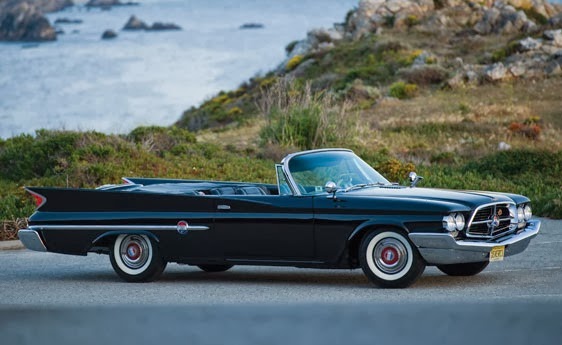
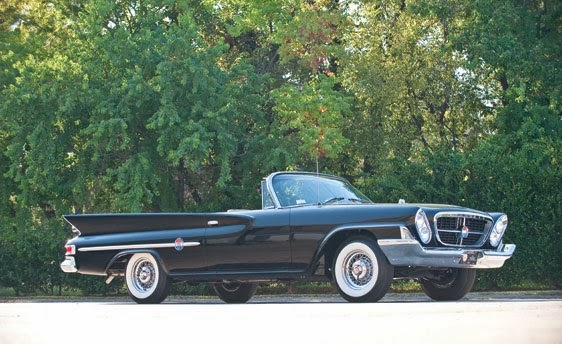
Chrysler 300G Convertible 1961
The Chrysler 300 "letter series" were high-performance luxury cars built in very limited numbers by the Chrysler Corporation in the U.S. from 1955–1965. Each year's model used a new letter of the alphabet as a suffix (skipping "i"), reaching 300L by 1965, after which the model was dropped.
The 300 "letter series" cars were among the vehicles that focused on performance built by domestic U.S. manufacturers after World War II, and thus can be considered one of the muscle car's ancestors, though much more expensive and exclusive.
Chrysler has recently started using these designations again for sporting high performance-luxury sedans, using 300M from 1999, and continuing the 300 series with a new V8-powered 300C, the top model of a relaunched Chrysler 300 line, a new rear-wheel drive car launched in 2004 for the 2005 model year. Unlike the first series, the second does not have 300 hp (220 kW) engines, except for Chrysler's current top-line 300C models.

1955 C-300
Chrysler C-300 1955


This first of the letter series cars didn't actually bear a letter; it can retroactively be considered the '300A'. The 'C-' designation was applied to all Chrysler models, however for marketing purposes the numerical series skipped more than 225 numbers forward in sequence in order to further reinforce the 300's bhp rating. The 300 originally stood for the 300 hp (220 kW) engine. The C-300 was really a racecar aimed at the NASCAR circuits that was sold for the road for homologation purposes, with Chrysler's most powerful engine, the 331 cu in (5.4 L) FirePower"Hemi" V8, due to the hemisperic shape of the combustion chambers, fitted with twin 4-barrel carburetors, a race-profiled camshaft setup, solid valve lifters, stiffer suspension and a performance exhaust system. By 1956 this would be the first American production car to top 355 hp (265 kW), and the letter series was for many years the most powerful car produced in the United States.
Chrysler C-300 1955

The car's "Forward Look" styling can be attributed as much to the Chrysler parts bin as designer Virgil Exner. The front clip, including the grille, was taken from the Imperial of the same year, but the rest of the car did not look like an Imperial. The midsection was from a New Yorker hardtop, with a Windsor rear quarter. Exner also included base-model Chrysler bumpers and removed many exterior elements such as back-up lights, hood ornament, side trim, and exterior mirrors. An electric clock and two-speed windshield wipers were standard. There were few options available including selection of three exterior colors (red, white and black) and only one color of tan leather interior. Power windows and power seat were available but air conditioning was not available in 1955. At least one known 1955 C-300 had A/C as a special order for a Chrysler executive.
Measured at 127.58 mph (205.32 km/h) in the Flying Mile, and doing well in NASCAR, the C-300 aroused a lot of interest that was not reflected in its modest sales figure of 1,725 built.
When the C300 competed in NASCAR, it was painted to advertise that it was the "world's fastest stock car".

1956 300B
Chrysler 300B Hardtop Coupe 1956


The 1956 300B was fairly similar externally, distinguished by a new tailfin treatment, but with larger engines, two models of 354 cu in (5.8 L)Hemi V8 with either 340 or 355 hp (254 or 265 kW). Only 1,102 were sold. Performance was a little better than the previous year's, being measured at almost 140 mph (225 km/h). A 6.17 ratio rear end was also added to the options. Front leg room was 44.6 inches. New was the Highway Hi-Fi phonograph player.
With the optional 355 hp 354 cu.in engine, the 300B became the first American car to produce 1 horsepower per cubic inch, besting Chevroletwith their fuel-injected 283 cu in (4.6 L) by one year.

1957 300C
Chrysler 300C Convertible 1957


The 1957 300C is generally considered the classic year of the 300 "letter series". New styling was brought in, with a yawning wide front grille and fins; the Hemi engine was upgraded to 392 cu in (6.4 L) with 375 hp (280 kW), or as a very limited edition 390 hp (290 kW) version (18 built). A convertible model was available for the first time. The car had a number of red, white, and blue '300C' medallions on the sides, hood, trunk and interior. 1,918 coupes and 484 convertibles were built. A/C was $495.

1958 300D
Chrysler 300D Convertible 1958 


The 1958 model year was to be the last use of the old FirePower Hemi in the 300. The engine was still 392 cu in (6.4 L), but tuned to 380 hp (280 kW) as standard. Thirty-five cars were built with fuel injection and delivered 390 hp (290 kW), but the fuel injection system was troublesome and most cars soon had it replaced with the standard twin-quad carburetor setup. A 300D was driven to 156.387 mph (251.680 km/h) at the Bonneville Salt Flats that year, but only 618 hardtops and 191 convertibles were produced, in part due to a recession in the economy.

1959 300E
Chrysler 300E Convertible 1959


1959 saw the Hemi engines replaced by Chrysler's new Golden Lion wedge-head V8 at 413 cu in (6.8 L) displacement(which Chrysler called "lion-hearted"). Power output remained about the same at 380 hp (280 kW). The loss of the Hemi and the late-1950s recession meant sales of 522 coupes and 125 convertibles. Power swivel seats were standard.

1960 300F
Chrysler 300F Convertible 1960


The 1960 300F introduced a new, higher power 413 cu in (6.8 L) Wedge engine delivering 375 hp (280 kW) in standard form. To boost power at lower and mid rpms, a special "cross-ram" intake manifold was derived. Instead of the normal V8 engine central intake manifold withcarburetor(s) on top, the cross-ram consisted of two pairs of 30 in (760 mm) long tuned pipes that criss-crossed so that each set fed the opposite side of the engine. The carburetors and air cleaners hung off the sides of the engine over the fender wells. These long tubes were tuned so that resonances in the column of air helped force air into the cylinders at those engine speeds. Also new were four individual, leather bucket seats with a full length console from dash to rear seatback. Swivelling front seats were fitted as standard equipment.
Chrysler 300F Four Speed Convertible 1960

A special 400 hp (300 kW) "short ram" version was produced for competition; in this, the tuned portion of the stacks was only 15 in (380 mm) long (though the overall tube length remained at 30"), so that the resonant effect was produced at higher engine speeds. Only 15 "short ram" cars were produced; these were also fitted with the exotic but often troublesome French Pont-a-Mousson 4-speed manual transmissions developed for the Chrysler-powered Facel Vega. Approximately 4 of these "Special GTs" are known to exist, including one convertible and one with air conditioning; it is believed that 15 were originally produced.
Chrysler 300F Convertible 1960

The bodywork was also redone for 1960, using Chrysler's new lightweight unibody construction and given sharper-edged styling with outward-tilting fins that were visually separated from sides. The "toilet seat" trunk lid contributed to a demeaning opinion of the 300F and was done away with after this one year of production.
Sales increased to 969 coupes and 248 convertibles.

1961 300G
Chrysler 300G Coupe 1961


The 1961 300G saw another restyle. The grille, formerly wider at the bottom than the top, was inverted; the quad headlights, formerly side-by-side, were arranged in angled fashion, inward at the bottom, in a manner reminiscent of 1958-1960 Lincolns. Small parking lamps below the headlights were likewise slanted and V-shaped, and the front bumper was canted up at each end, scoop-like. At the rear, the taillights were moved from the fins to the tail below them, and the fins were made sharper-pointed. Power windows were standard.
Chrysler 300G Convertible 1961

Mechanically, the cross-ram "short ram" and "long ram" engines remained the same, although the expensive French manual transmissionwas dropped, and replaced by a more reliable and still expensive Chrysler racing manual transmission (referred to as 'option code 281'). There are currently only five cars with this transmission. Code 281 cars may have been built for the 1961 Daytona Flying Mile, although like the 1960 F Specials, no specific records were kept by Chrysler. Unlike the 300F Specials (which were randomly pulled from the line and upgrade for the Flying Mile), the 300Gs had a specific build code (281).

1962 300H
Chrysler 300H Convertible 1962


From 1962s 300H, the fins were gone, as was the letter series' unique place in the Chrysler lineup; there was now a whole Chrysler 300 Sport Series (which included a four-door hardtop along with a two-door hardtop and convertible), along with the 300H. Externally there was little difference between the 300H and the 300 Sport Series(except for a "300H" badge on the driver's side of the trunk), and many of the 300H's features could be ordered as options on the other models. Under the hood of the 300H the cross ram intake was gone, and there was a return to the inline dual 4-barrel carb setup of the 300E. With a slight power boost and a 300 lb (140 kg) lighter body, the 300H was faster than the 300G, but the loss of exclusivity coupled with high prices made this the slowest-selling letter series year yet, with only 435 coupes and 135 convertibles sold. The regular 300 (non-letter) series used a 383 cu in (6.3 L) B engine.
All 300s for 1962 were demoted to the Chrysler Newport/Dodge 880 122-inch wheelbase body.

1963 300J

Further restyling for the 1963 300J (the letter "I" was skipped because people would confuse it for the numeral "1".) left the car with a smoother, more angular 1960s look. (Shared with the Newport and New Yorker series, this body design was the last one styled during Virgil Exner's term as Chrysler's styling chief.) The letter-series convertible was dropped, leaving the hardtop. The only engine available was the 413 cu in (6.8 L) ram-induction V8, with an increase of 10 hp (7.5 kW) from 1962. A redesigned and more sumptuous interior featured an oddly squared steering wheel. The 300J was faster than the standard 300H of the year before, with a 142 mph (229 km/h) top speed, 8.0 seconds 0-60 mph, and a standing quarter mile time of 15.8 seconds with a terminal velocity of 89 mph (143 km/h). Sales were especially poor, with only 400 cars produced. As for the non-letter 300, the 300 convertible was the official pace car for the 1963 Indianapolis 500-Mile Race. Power steering was standard.

1964 300K

The convertible returned for the 1964 300K, but the "cross-ram" engine became an extra-cost option available on the 300K only. A 413 cu in (6.8 L) Wedge with a single Carter AFB 3614S 4-barrel carburetor, a regular intake manifold, and 360 hp (270 kW) was the new standard engine. Leather upholstery was no longer standard either. All this reduced the baseline price by over a thousand dollars, and sales responded with the largest total ever; 3,022 coupes and 625 convertibles. A center console was standard.

1965 300L

The 1965 300L was the final year of the traditional letter series. A complete restyle, with crisp lines, slab sides and a tall "greenhouse"—styling cues introduced by Elwood Engel when he succeeded Virgil Exner as Chrysler's styling boss—brought a sleek mid-1960s linear look to the cars, and dropped the panoramic windshield that had disappeared from other Chrysler models in 1961. The cross-ram engine was no longer available; the413 cu in (6.8 L) engine with regular carburetion and inlet manifold was the only one supplied. Practically every feature on the 300L could be ordered as an option on the regular 300; the only absolute difference was the '300L' badges. 2,405 coupes and 440 convertibles were sold.