Se afișează postările cu eticheta Austin-Healey. Afișați toate postările

sâmbătă, 21 mai 2016

Austin-Healey 100 BN1 1954 - World Of Classic Cars -


The Austin Healey 100 was built from 1953 until 1956 and developed by Donald Healey to be produced in-house by Healey's small car company in Warwick. Healey built a single Hundred for the 1952 London Motor Show and the design impressed Leonard Lord, Managing Director of Austin, so much, that a deal was struck with Healey to build it at Austin's Longbridge factory and renamed the Austin-Healey 100.


The name came from Donald Healey who selected it due to the car's ability to reach 100mph, as opposed to the Austin-Healey 3000, duly named for its 3,000cc engine. Production Austin-Healey 100s were finished at Austin's Longbridge plant. The 100 was the first of three models later called the Big Healey's to distinguish them from the much smaller Austin-Healey Sprite.


The first series 'BN1' were equipped with the same 90bhp engines and manual gearbox as the A90 although the transmission was modified to be a three-speed unit with overdrive on second and top. With only 6% of these early Healey's sold in the UK, their scarcity alone has made them hugely collectable, this combined with their competition potential in many of the worlds classic rallies makes for a desirable sportscar in any collection.


This Australian delivered righthand drive BN1 was bought into the UK in 2012 by a young businessman. His intention was to fully restore the car and tour the south of France with his father. Having sourced a car from the dry climate of Kirrawee, New South Wales, it was immediately set about by renowned Healey specialists, JME Healeys of Warwickshire.


JME's initial remit was to make the car both reliable and comfortable for what would have been a long pan-European jaunt. The mechanical work list included a complete suspension overhaul, steering, brakes overhaul, new rear axle, clutch and gearbox overhaul, fuel system, electrical, chassis repairs and finally a full service, the work was to be undertaken with a blank chequebook philosophy with labour alone costing £7,700.


miercuri, 20 aprilie 2016

Austin-Healey 100S 1955 - World Of Classic Cars -

Austin-Healey 100S 1955

In 1952, Healey had struck a deal with Austin for them to build his “Healey Hundred” in far greater quantity than his tiny Warwick-based company ever could have. Perhaps the key element of that effort was development and creation of the 100S, a car conceived not to make a profit but rather to boost the marque’s sporting image by its appearance on race tracks around the world.
It was developed throughout 1953 and 1954, and what emerged was a car that looked similar to the standard 100 but had scores of improvements and modifications incorporated to make it more reliable and competitive in racing. As with any racing car, weight was always a principal concern, and to lighten the 100S, an all-alloy body was used, along with an alloy substructure. The result was a curb weight of 905 kilograms, compared to 987 kilograms for the standard car.
Austin-Healey 100S 1955

The engine was also highly modified, resulting in a power increase from 90 to 132 brake horsepower. This was achieved by dozens of modifications, with the most noticeable being a specially designed eight-port aluminium Weslake cylinder head with larger valves, a high-lift camshaft, a nitride-hardened crankshaft, and forged-steel connecting rods. Although labelled an “Austin” engine, they were actually made at the Morris engine plant in Coventry. Other notable features on the 100S are the brakes: Dunlop hydraulic disc brakes at all four corners were cutting-edge technology in the mid-1950s.

CHASSIS NUMBER AHS-3707
Austin-Healey 100S 1955

This car, AHS-3707, is the seventh 100S of the third batch of ten. It was shipped on 21 April 1955 as one of six sent to Gough Industries in Los Angeles, where the popularity of sports car racing was at a fever pitch. This car, finished in the classic and model-signature combination of Old English White and Lobelia Blue, was used exactly as intended, competing in numerous races at Pomona, Palm Springs, Santa Barbara, and Riverside, amongst other venues around Southern California and Nevada.
Although the original owner is unknown, the ownership history has been continuous since early 1959, when the car was purchased by Bob Schilling from a used car lot on Crenshaw Boulevard in Los Angeles. He would race the car on and off from 1960 to 1962, until he sold the Austin-Healey to Louise Grey-Young, of North Hollywood, in 1964. It subsequently traded hands several times over the years, with other notable caretakers including well-known and highly respected car collectors Jon Savage and Craig McCaw.
Austin-Healey 100S 1955

The car maintains an outstanding appearance, as it was restored in the mid-1980s at a reported cost of over $200,000, with the work being finished by renowned specialist restorers (Phil) Hill & Vaughn. In fact, under its current ownership, the car has been looked after by Woolmer Classic Engineering Ltd. (which maintains the vast majority of 100Ss residing and competing in the UK). They report:
The original chassis and body plates are fitted. The chassis and body appear to be largely/completely original. The chassis welding is to the correct specification. All of the outer panels are the correct shape and dimensions; the original body number stampings are clearly visible on both the bonnet and boot lid.
Austin-Healey 100S 1955

The interior has been re-trimmed, presumably when the car was restored in the 1980s, the seats now have a nice patina and retain their original foam cushions, giving them the correct shape and feel. All of the instruments and switches are to original specification and presumably original to the car, as is the steering wheel. The correct original gearbox filler cover is still fitted to the tunnel.
The car retains its original engine and a correct-specification 100S gearbox, almost certainly the original for the car. The differential has been changed for a production-specification 3.66:1 unit, which makes the car much more useable on both road and track.
Austin-Healey 100S 1955

The brake callipers retain their original, very rare early Dunlop piston bodies with wear indicators.
Mechanically, the car is in very good order, the engine starts readily and shows the correct oil pressure when hot, and the gearbox has a good change up and down, with synchromesh working correctly in 2nd, 3rd, and 4th. The four-wheel disc brakes are strong. The steering is direct, and the car drives precisely as a correct-specification 100S should.
Although it has been about 30 years since it was fully restored, this 100S maintains an outstanding appearance, including a lovely patina, which is the result of careful use and proper storage and maintenance. Within just the last few years it has also benefited from considerable attention to mechanical excellence, which included crack-testing and rebuilding all the steering, suspension, brakes, and new wheels. It was last raced at Monterey, California, in August 2012 and then shipped back to the UK, where it was subsequently serviced and thoroughly checked, with the rear axle and half shafts being rebuilt to assure outstanding mechanical condition.

luni, 4 aprilie 2016

Austin-Healey 100 M 'Le Mans' 1956 - World Of Classic Cars -

Austin-Healey 100 M 'Le Mans' 1956

The 100 M traces its roots directly back to the 1953 Le Mans 24-hour race where two lightly modified examples of the new Austin-Healey 100 stunned the motoring world by finishing 12th and 14th overall in a field composed of purpose-built racecars. Subsequent customer enthusiasm for performance upgrades for their standard cars resulted in marketing the “Le Mans Engine Modification Kit” that incorporated the modifications made to those two Le Mans entries.
Such was the demand for these upgrades that in 1955 the Donald Healey Motor Company and the British Motor Corporation partnered to produce a new model that incorporated those upgrades plus high-compression pistons, a louvered bonnet and bonnet strap, a larger anti-sway bar, and special-setting shock absorbers. The new model was designated the 100 M and was introduced at the 1955 London Motor Show at Earls Court. Sold concurrent with the standard Austin-Healey 100, series BN2, a total of just 640 100 Ms were produced, representing just 14 percent of production.
Austin-Healey 100 M 'Le Mans' 1956

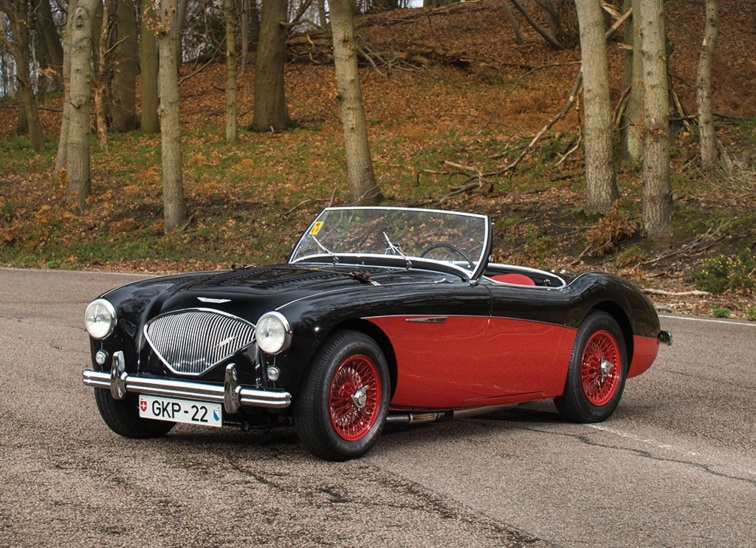
The example presented here is finished in what many consider to be the most striking and exciting color combination of black over Reno Red. Coupled with a red interior of the finest leather, vinyl, and carpet by Heritage Upholstery, this 100 M simply commands attention and admiration wherever it is driven or shown. Completed in February 1956, this left-hand-drive export model is equipped with its matching-numbers engine, a laminated windscreen, wire wheels, a speedometer in mph, a heater, and of course the 100 M trademark louvered bonnet. It was sold new in Cincinnati, Ohio, in 1956, and the ownership succession is known back to 1958 when it was purchased from the original owner.
Austin-Healey 100 M 'Le Mans' 1956

A nut-and-bolt restoration was completed in 2009 by Brian Nicholson at Britannic Motors in Avon, Massachusetts. Body panel fit and gaps are outstanding, and the paint was applied by Bob Lundell of Hanson, Massachusetts, using DuPont black and correct Reno Red from R&R Paint Supply of Long Beach, California. The highest level of attention to detail is exemplified by the curved break between the black and red behind the front wheel opening; it was made using a template provided by the Worldwide 100 M Le Mans Registry. All mechanical work was done to the highest standard using original specification parts from the UK.

duminică, 3 aprilie 2016

Austin-Healey 3000 Mk I BN7 1960 - World Of Classic Cars -

Austin-Healey 3000 Mk I BN7 1960

Introduced in 1959, the British Motor Company launched the Austin-Healey 3000, which would quickly become the marque’s defining model. Fitted with a 2,912–cubic centimeter motor rated at 124 horsepower, it was the most powerful “Big Healey,” and BMC was eager to prove their newest model’s worth in the crucible of motorsport.
The new Austin Healey quickly proved to do just that. Pat Moss, sister of Sir Stirling Moss, piloted the new 3000 to first place overall at the 1960 Liège-Rome-Liège Rally and the Coupe des Dames at the Geneva rally that same year.
Austin-Healey 3000 Mk I BN7 1960

Don and Earl Morley won the 1960 Alpine Rally outright in a 3000 as well. Most impressively, a factory-entered 3000 finished second in class at the 1960 12 Hours of Sebring, with 1st place going to a Ferrari 250 GT LWB California Spider. Success at the track quickly translated into success in the showroom, and the new 3000 helped to establish the Austin-Healey name in the burgeoning sports car industry worldwide.
Restored in 2009 to concours standards by the marque specialists at Kurt Tanner Restorations, this particular Austin-Healey 3000 Mk I BN7 was Mr. Tanner’s personal car and was later purchased by its current owner. Since its completion, the car’s impeccable restoration has been very well preserved. Finished in the highly attractive color scheme of Opalescent Silver Grey over a Red leather interior, the Austin-Healey presents incredibly well.
Austin-Healey 3000 Mk I BN7 1960

Of the two-seater BN7 model, only 10,785 examples were produced for the 1960 model year, and 2,825 Mk I BN7s were built from 1959 to 1961. Much more desirable than their four-seater siblings, the two-seater 3000 Mk I BN7s were the definitive British sports cars of the era, just as exciting to drive on the track as they were on a winding countryside road. Considered by many to be one of the prettiest Austin-Healeys ever built, the 3000 Mk I BN7 has always been well regarded in enthusiast circles as an excellent motor car in every right.

vineri, 25 martie 2016

Austin-Healey 100 M 'Le Mans' 1956 - World Of Classic Cars -

Austin-Healey 100 M 'Le Mans' 1956

When the Healey Hundred was unveiled by the Donald Healey Motor Company at Earls Court in London in October 1952, it created a significant stir. Sleek lines, 100-mph capability, and an affordable price made this the dominant sports car the day it was introduced. It was no wonder that Leonard Lord of British Motor Corporate immediately contracted for the car to be badged as the Austin-Healey and produced in commercial numbers at the Austin plant in Longbridge.
However, by 1955, other competitors had entered the field, and demand was declining. To enable dealers to move stock on the floor, Healey began supplying them with “Le Mans Modification Kits.” The kits included a hotter camshaft, an improved distributor, bigger 1.75-inch carburetors, and a cold-air intake box, upgrades the company had used to good effect at Le Mans in 1954. The kit could upgrade the car’s performance from 90 horsepower to 103 horsepower. Subsequently, dished pistons were added to the kit, adding another seven horsepower.
Austin-Healey 100 M 'Le Mans' 1956

With good initial success, BMC decided to offer the model as a variant to the new BN2, with the addition of a louvered bonnet with racing strap to be fitted on the Jensen production line and, usually, a two-tone paint scheme for visual identification. Dubbed by the marketing department the 100 M, the new model was introduced at Earls Court in October 1955.
The production process for the 100 Ms was complicated; after the body arrived at Longbridge and was mated with its suspension and engine, it was trucked to the Healey facilities in Warwick, where the Le Mans camshaft and pistons were installed along with the carburetors, cold-air box, and distributor. The finished car was then trucked back to Longbridge for shipment to the dealer.
Austin-Healey 100 M 'Le Mans' 1956

Though very popular, by mid-1956, the Healey BN2 and its offshoot 100M were taken out of production, to be replaced by the redesigned Healey 100-6 two-plus-two model. Consequently, only 640 units were ever produced by the factory.
This example, restored from the chassis up to show standards, displays every one of the characteristics that denote the rare 100 Ms. The car’s body number is certified by British Motor Industry Heritage Trust to have been one of the original 640 fitted by Jensen with the louvered hood, the only common criterion for all 100 Ms. Confirming that this example has that body, the cockpit rails that were hand-fitted to each car bear the correct body number stamping. The exterior colors and Heritage Upholstery interior are all period correct.

joi, 25 februarie 2016

Austin-Healey 100 M 'Le Mans' 1956 - World Of Classic Cars -

Austin-Healey 100 M 'Le Mans' 1956

After building more than 10,000 of their original BN1s in three years, more than half of which were exported to the United States, Austin introduced a new Healey model known as the BN2 for 1955. This car featured a four-speed transmission and was offered both in standard trim and as a new “hot” model, the 100 M. This model adopted larger carburettors, a high-lift cam, higher 8.1:1 compression, stiffer front suspension, and a louvered hood, which was secured by a leather strap. These engine modifications, with the exception of the high-compression pistons, could be dealer-installed as the Le Mans kit, and they were also available at the parts counter for owner application. True factory-built 100 M Le Mans Roadsters accounted for only 640 cars, which are all tracked and documented by a dedicated registry and confirmed by the British Motor Industry Heritage Trust.
Austin-Healey 100 M 'Le Mans' 1956

This factory-built car is documented by its BMIHT certificate as being one of those 640 examples. It was originally built with left-hand drive for American export and was finished in the same colour combination that it wears today, Black and Reno Red. It is also still powered by its original engine. This car has been well cared for over the years, and it displays an impressive level of craftsmanship, including a new red and black interior with colour-coordinated carpet and a black top. The engine bay, with its polished surfaces, is also very presentable.

sâmbătă, 6 februarie 2016

Austin-Healey Mk. III 1966 - World Of Classic Cars -

Austin-Healey Mk. III 1966

The Austin-Healey 3000 was built from 1959 to 1967 and is the best known of the 'big' Healey models. The car's bodywork was made by Jensen Motors and the vehicles were assembled at the BMC Abingdon works. The 3000 was a successful car which won its class in many European rallies during its heyday and also ran at Le Mans during that period. As such, it's still used in competition by enthusiasts today. The 3000 Mk. III was launched in October 1963 and remained in production until the end of 1967 when production of Austin-Healeys ceased. Classified as the BJ8, the new model was the most powerful and luxurious of the big Healeys with a walnut veneer dash, wind-up windows and a 150bhp engine. Improvements to the engine included a new camshaft, valve springs and twin SU 2" HD8 carburettors together with a redesigned exhaust system and servo-assisted brakes.

joi, 21 ianuarie 2016

luni, 20 aprilie 2015

Austin A35 - World Of Classic Cars -

Austin A35 Saloon 1959

Introduced in 1956, the A35 replaced the highly successful Austin A30. The name reflected the larger and more powerful 34hp A-Series engine enabling a slightly higher top speed and better acceleration. Similar in appearance to the A30 except for a larger rear window aperture and a painted front grill with chrome horse-shoe surround, both had 13"" wheels and was offered as a two or four door saloon, 'Countryman' estate and van. The A35 was a successfully raced in its day and can still be seen today at historic race meetings.

Austin Sprite - World Of Classic Cars -

Austin Sprite Mk. IV 1970

First introduced at Monte Carlo by the British Motor Corporation (BMC) on the 20 May1958 and intended as a low-cost model, the Sprite was designed by the Donald Healey Motor Company, which received a royalty payment from the manufacturers BMC. The low cost of £669 was achieved by using a mildly tuned version of the A Series engine and as many other components from existing cars as possible.
Manufactured at the MG sports car factory at Abingdon, it was not surprising  that the success of the design would lead to an MG version, this was  known as the Midget.  These cars, the Sprites and MG Midgets are often now known as ""Spridgets"".  The final version of the Austin Healey Sprite arrived in 1966, as the Mk IV. The new model now used a twin carb 1275cc version of the proven A Series engine, which it shared with other BMC models such as the Mini Cooper S.  Another major improvement was the addition of a folding hood; previous models consisted of a separate hood cover and frame.  In 1969 a ""British Leyland"" makeover was applied to the Sprite, consisting of matt black paint on the sills, Rostyle wheels and a plastic front grille. Between 1969 and 1970, the Austin Healey name disappeared and all cars were now sold as Austin Sprites.

duminică, 29 martie 2015

Austin-Healey 3000 - World Of Classic Cars -

Austin-Healey 3000 Mk.III BJ8 1967

The Austin-Healey 3000 is a British sports car built from 1959 to 1967, and is the best known of the 'big' Healey models. The car's bodywork was made by Jensen Motors, and the vehicles were assembled at the BMC Abingdon works. The Austin Healey 3000 MK3 was launched in October 1963 and remained in production until the end of 1967, when production of Austin Healeys ceased. Classified as the BJ8, the new model was the most powerful and luxurious of the big Healeys, with a walnut-veneer dash, wind-up windows, and a 150 hp (112 kW) engine. Improvements to the engine included a new camshaft and twin SU 2"" HD8 carburettors, together with a new exhaust system. Servo-assisted brakes were now fitted as standard. Only 2+2 seat versions were made. The 3000 was a successful car which won its class in many European rallies in its heyday - and is still used in competition by enthusiasts today.

duminică, 10 august 2014

Austin-Healey 100M 'Factory' Le Mans BN2 Roadster 1956 - World Of Classic Cars -

Austin-Healey 100M 'Factory' Le Mans BN2 Roadster 1956

Donald Healey, a top rally driver before World War II, had been the technical director of Triumph and built his own line of Riley-powered sports cars after the war. Looking for a more modern design, he worked up a new car by using the powertrain from Austin’s A90 Atlantic, which was a baroque-looking convertible that was intended for American consumption but had received a disappointing reception. The new car’s engine was a 2,660-cubic centimeter four-overhead-valve unit that could produce 90 brake horsepower, and the transmission was a three-speed version of the Atlantic’s that was coupled with a Laycock de Normanville overdrive. Healey had negotiated the supply of components with Austin’s chairman, Leonard Lord. When the car, badged as the Healey Hundred, appeared at the 1952 Earls Court Motor Show, Lord was so taken with it that the two men immediately struck a deal for Austin to produce it. The first cars, re-named Austin-Healey 100, appeared the following spring.
Austin-Healey 100M 'Factory' Le Mans BN2 Roadster 1956

Donald Healey himself was timed at 142.636 mph in a lightly modified example at the Bonneville Salt Flats in 1953, and he set a number of speed and endurance records, allowing the advertising department to proclaim: “It’s fast! It’s dependable! It’s record breaking!” Production topped 10,000 in three years, with more than half of them being exported to the United States.
In 1955, a new BN2 version of the Austin-Healey, which had a four-speed transmission, was introduced. At the same time that the BN2 was introduced, a new model, which was based on the BN2 and named the 100M, was also introduced.
Austin-Healey 100M 'Factory' Le Mans BN2 Roadster 1956

It featured larger carburetors, a high-lift cam, and a higher 8.1:1 compression. Stiffer front suspension was fitted, with hood louvers and a leather strap completing its bona fides. The engine mods, with the exception of the high-compression pistons, could be dealer-installed as the Le Mans kit, or it was also available at the parts counter for owner application. The factory-installed Le Mans package raised the 100’s 90 brake horsepower to an impressive 110.
This 1956 100M is one of 640 made by the factory, and it was purchased by the current owner in the summer of 2011. A complete restoration commenced after the purchase, which included taking the car completely apart, including the body, frame, engine, transmission, brakes, and steering. Everything was then rebuilt, including a new fuel tank, with new parts where the old ones were not deemed 100 percent correct and in top condition. During inspection, the car was found to have all the criteria necessary to authenticate a factory 100M: all four cockpit surrounds are correctly stamped, as are the boot lid and bonnet, with the latter being the original louvered one. There are correct, marked carburetors and an induction manifold, and the engine compartment has been modified to make room for them. Additionally, this 100M retains its original and correctly stamped distributor. The engine was completely rebuilt with some performance upgrades, such as a lighter flywheel. The original four-speed overdrive gearbox was rebuilt, too.
Austin-Healey 100M 'Factory' Le Mans BN2 Roadster 1956

The seats were very good, with a little bit of patina, which the owner preferred to new leather, and they have been retained. The car is painted in correct Healey Blue over white, with a dark blue interior. New high-quality paint was applied, and new carpets have been installed throughout, including a new boot lining. Extra driving lights were also fitted.
The restoration was done by Greg Perry at Vintage Motor Cars, of Mesa, Arizona, and it took a year-and-a-half to complete, at a cost of about $90,000. The engine was air flowed and tuned by Jim Unsworth, of flow bench fame.

joi, 28 noiembrie 2013

Austin- Healey 100-6 - World Of Classic Cars - Rank 73

Austin-Healey 100-6 BN4 Roadster 1957

The Austin-Healey 100-6 was the second of the three Austin-Healey models later known as the Big Healeys. It was introduced in 1956 to replace the Austin-Healey 100.
It featured a 2 in (50.8 mm) longer wheelbase than the original Austin-Healey 100 and a six-cylinder engine replacing the slightly larger capacity four, and added two occasional seats which later became optional. The body lines were changed to a less rounded appearance, with a wider, lower radiator grille below the air scoop which was added to the bonnet, and a windscreen which was fixed and could no longer be folded down.
There were two model designators, the 2+2 BN4 produced from 1956 onwards and the 2-seat BN6 produced from 1958.
Austin-Healey 100/6 BN6 Sports Roadster 1959

The cars used a tuned version of the BMC C-Series engine previously fitted to the Austin Westminster and which at first produced 102 bhp (76 kW) increasing to 117 bhp (87 kW) in 1957 by fitting a revised manifold and cylinder head. The overdrive unit became an option rather than a standard fitting.
In late 1957 production was transferred from Longbridge to the MG plant at Abingdon.
A 117 bhp (87 kW) BN6 was tested by The Motor magazine in 1959 had a top speed of 103.9 mph (167.2 km/h) and could accelerate from 0-60 mph (97 km/h) in 10.7 seconds. A fuel consumption of 20.8 miles per imperial gallon (13.6 L/100 km; 17.3 mpg-US) was recorded. The test car cost £1307 including taxes of £436.
Austin-Healey 100/6 BN6 Roadster 1958

marți, 19 noiembrie 2013

Austin-Healey 3000 - World Of Classic Cars - Rank 66

The Austin-Healey 3000 is a British sports car built from 1959 to 1967, and is the best known of the "big" Healey models. The car's bodywork was made by Jensen Motors, and the vehicles were assembled at the BMC Abingdon works.
Austin-Healey 3000 Mark III BJ8 Convertible 1965

The 3000 was a successful car which won its class in many European rallies in its heyday, and is still used in competition by enthusiasts today.
The Austin-Healey 3000 was introduced in 1959, replacing the Austin-Healey 100-6. Despite the name change, the changes were relatively minor compared to those between the original 100 and the 100-6. The wheelbase and body remained unchanged, and there remained two models, a 2+2 and a two-seater.

Mark I 
Austin-Healey 3000 Mark I BT7 Roadster 1960


The original Austin Healey 3000 has a 2912 cc I6 engine, with twin SU carburetors and Girling front disc brakes. It was only referred to as the Mark I after the Mark II was released, previously only being known as the 3000. Wire wheels, overdrive gearbox, a laminated windscreen, a heater, an adjustable steering column, a detachable hard top and two tone paint were all available as options.
The original 3000 was built from March 1959 to March 1961 and has model designation BT7 Mark I (4-seat version) and BN7 Mark I (2-seater).
Austin-Healey 3000 MKI BT-7 Roadster 1959

A total of 13,650 were made (2,825 BN7 Mark I, and 10,825 BT7 Mark I).
A BT7 3000 with hardtop and overdrive tested by The Motor magazine in 1960 had a top speed of 115 mph (185 km/h) and could accelerate from 0–60 mph (97 km/h) in 11.7 seconds. A fuel consumption of 21.6 miles per imperial gallon (13.1 L/100 km; 18.0 mpg-US) was recorded. The test car cost £1326 including taxes.

Mark II
Austin-Healey 3000 Mk II Convertible 1963


Introduced in March 1961, the 3000 Mark II came with three SU HS4 carburettors and an improved camshaft, designated the BT7 Mark II (4-seat version) and BN7 Mark II (2-seat version). However, upon the introduction of the BJ7 (2+2 seats) model in January 1962, the number of carburettors was reduced to two, (SU type HS6) because of the problems experienced with balancing three carburettors. As a result of the introduction of the BJ7, the BN7 Mark II was discontinued in March 1962, and the BT7 Mark II followed in June 1962. Externally, the main changes introduced with the BJ7 were a vertical barred front grille, wind-up windows rather than side curtains, an improved hood, and a wrap-around windscreen. Optional extras were similar to the Mark I, although the option of a factory hardtop was not available from the BJ7's introduction. From August 1961 a brake servo was also available as an optional extra, which greatly improved braking performance. The BJ7 was discontinued in October 1963 with the introduction of the 3000 Mark III.
Austin-Healey 3000 MK II BT7 Roadster 1962

A 3000 Mark II BT7 with hardtop and overdrive tested by the British magazine The Motor in 1961 had a top speed of 112.9 mph (181.7 km/h) and could accelerate from 0–60 mph (97 km/h) in 10.9 seconds. A fuel consumption of 23.5 miles per imperial gallon (12.0 L/100 km; 19.6 mpg-US) was recorded. The test car cost £1362 including taxes.
A total of 11,564 were made: 355 BN7 Mark II, 5,096 BT7 Mark II, and 6,113 BJ7.

Mark III
Austin-Healey 3000 Mark III BJ8 Roadster 1967


The 3000 Mark III was launched in October 1963, and remained in production until the end of 1967 when production of Austin-Healeys ceased. (One further car was built in March 1968.) Classified as the BJ8, the new model was the most powerful and luxurious of the big Healeys, with a walnut-veneer dash, wind-up windows, and a 150 hp (112 kW) engine. Improvements to the engine included a new camshaft and valve springs, and twin SU 2" HD8 carburetors, together with a new design of exhaust system. Servo-assisted brakes were now fitted as standard. Only 2+2 seat versions were made. Option extras were similar to those offered for the Mark II, the main change being that the standard interior trim was now Ambla vinyl, with leather seats being added to the list of options.
Austin-Healey 3000 BJ8 MK III Convertible 1965

In May 1964 the Phase II version of the Mark III was released, which had a modified rear chassis to allow rear ground clearance to be increased, and subsequently, in March 1965 the car also gained separate indicators.
A total of 17,712 were made.

Competitions

Austin Healey 3000's have a long competition history, and raced at most major racing circuits around the world, including Sebring (USA), Le Mans (France), and Mount Panorama Circuit, Bathurst(Australia). The BMC competitions department successfully rallied the 3000 from its introduction, but the development of the works cars effectively ended in 1965, mainly because of the success of the Mini Cooper 'S'.

vineri, 1 noiembrie 2013

Austin-Healey Sprite - World Of Classic Cars - Rank 48

The Austin-Healey Sprite is a small open sports car that was announced to the press in Monte Carlo by the British Motor Corporation (BMC) on 20 May 1958, just before that year's Monaco Grand Prix. It was intended to be a low-cost model that "a chap could keep in his bike shed", yet be the successor to the sporting versions of the pre-war Austin Seven. The Sprite was designed by the Donald Healey Motor Company, which received a royalty payment from the manufacturers BMC. It first went on sale at a price of £669, using a mildly tuned version of the Austin A-Series engine and as many other components from existing cars as possible to keep costs down.
The Sprite was made at the MG sports car factory at Abingdon and it was inevitable that the success of the design would spawn an MG version known as the Midget, reviving a popular pre-war model name. Enthusiasts often now refer to Sprites and MG Midgets collectively as "Spridgets."

Mark I

The little Sprite quickly became affectionately known as the Frogeye in the UK and the Bugeye in the US, because its headlights were prominently mounted on top of the bonnet, inboard of the front wings. The car's designers had intended that the headlights could be retracted, with the lenses facing skyward when not in use; a similar arrangement was used many years later on the Porsche 928. But cost cutting by BMC led to the flip-up mechanism being deleted, therefore the headlights were simply fixed in a permanently upright position, giving the car its most distinctive feature. The body was styled by Gerry Coker, with subsequent alterations by Les Ireland following Coker's emigration to the US in 1957. The car's distinctive frontal styling bore a strong resemblance to the defunct American 1951 Crosley Super Sport.
Austin-Healey Bugeye Sprite 1958

The problem of providing a rigid structure to an open-topped sports car was resolved by Barry Bilbie, Healey's chassis designer, who adapted the idea provided by the Jaguar D-type, with rear suspension forces routed through the bodyshell's floor pan. The Sprite's chassis design was the world's first volume-production sports car to use unitary construction, where the sheet metal body panels (apart from the bonnet) take many of the structural stresses. The two front chassis legs projecting forward from the passenger compartment mean the shell is not a fullmonocoque however. The front sheet-metal assembly, including the bonnet (hood) and wings, was a one-piece unit, hinged from the back, that swung up to allow access to the engine compartment. The 43 bhp, 948 cc OHV engine (coded 9CC) was derived from the Austin A35 &Morris Minor 1000 models, also BMC products, but upgraded with twin 1" inch SU carburettors. The rack and pinion steering was derived from the Morris Minor 1000 and the front suspension from the Austin A35. The front suspension was a coil spring and wishbone arrangement, with the arm of the Armstrong lever shock absorber serving as the top suspension link. The rear axle was both located and sprung by quarter-elliptic leaf springs, again with lever-arm shock absorbers and top links. There were no exterior door handles; the driver and passenger were required to reach inside to open the door. There was also no boot lid, owing to the need to retain as much structural integrity as possible, and access to the spare wheel and luggage compartment was achieved by tilting the seat-backs forward and reaching under the rear deck, a process likened to potholing by many owners, but which resulted in a large space available to store soft baggage.
Austin-Healey Bugeye Sprite Convertible 1960


Engine:1958–61: 948cc cc A-Series I4, 43 hp (32 kW) at 5200 rpm and 52 lbf·ft (71 Nm) at 3300 rpm
A car was tested by the British magazine The Motor in 1958. It had a top speed of 82.9 mph (133.4 km/h) and could accelerate from 0-60 mph (97 km/h) in 20.5 seconds. Fuel consumption of 43 miles per imperial gallon (6.6 L/100 km; 36 mpg-US) was recorded. The test car cost £678, including taxes of £223
The BMC Competition Department entered Austin Healey Sprites in major international races and rallies, their first major success coming when John Sprinzel and Willy Cave won their class on the 1958 Alpine Rally. Private competitors also competed with much success in Sprites. Because of its affordability and practicality, the Austin Healey Sprite was developed into a formidable competition car, assuming many variants by John Sprinzel, Speedwell and WSM. The Sebring Sprite became the most iconic of the racing breed of Austin Healey Sprites. Many owners use their Austin Healey Sprites in competition today, fifty years after its introduction.

Mark II

The Mark II used the same 948 cc engine (engine code 9CG) but with larger twin 1¼ inch SU carburettors increasing power to 46.5 bhp and a close-ratio gearbox. The bodywork was completely revamped, with the headlights migrating to a more conventional position in the wings, either side of a full-width grille. At the rear, styling borrowed from the soon-to-be-announced MGB gave a similarly more modern look, with the added advantages of an opening boot lid and conventional rear bumper bar. The result was a much less eccentric-looking sports car, though at the expense of some 100 lbs extra weight. In contrast to the 'frogeye', the later cars are often collectively referred to as square-bodied Sprites by enthusiasts.
Austin-Healey Sprite Mark II 1963

An MG version of the car was introduced in May 1961 as, 'the new Midget,' reviving a model name which had been a great success for the MG Car Company in the 1930s. The Midget was to prove more popular with the public than the Sprite and by 1972 had completely supplanted it within the BMC range. In October 1962 both Sprites and Midgets were given a long-stroke 1098 cc engine (engine code 10CG), which was also fitted in single carburettor form to the Austin A40 and Morris Minor 1000 (which nevertheless remained the Minor 1000). A strengthened gearbox with Porsche (baulk-ring) synchromesh was introduced to cope with the extra power - a heady 56 bhp. Front disc brakes were also introduced at the same time and wire wheels became an option.
Austin-Healey "Sebring Sprite" 1961

Innocenti also produced their own version of the Sprite, using the standard production underframe (initially shipped out from England), but clothed in the sharpest of Italian suits, styled by the American Tom Tjaarda, then working at Carrozzeria Ghia. The Innocenti 950 Spider and later 1100 Spider were produced from 1961 until 1968.
A car with hardtop tested by the British magazine The Motor in 1961 had a top speed of 85.8 mph (138.1 km/h) and could accelerate from 0–60 mph (97 km/h) in 20.0 seconds. A fuel consumption of 43.5 miles per imperial gallon (6.49 L/100 km; 36.2 mpg-US) was recorded. The test car, which was to de-luxe specification cost £705 including taxes of £208.
Engines:1961–64: 948 cc A-Series I4, 46 hp (34 kW) at 5500 rpm and 53 lbf·ft (72 Nm) at 3000 rpm
             1962–64: 1098 cc A-Series I4, 56 hp (42 kW) at 5500 rpm and 62 lbf·ft (84 Nm) at 3250 rpm

Mark III

The Mark III Sprite was also marketed as the Mark II MG Midget – differences between the two were again restricted to minor trim detailing. Although still 1098 cc, the engine had a stronger block casting, and the size of the crankshaft main bearings was increased to two inches (engine code 10CC).
Austin-Healey Sprite Convertible 1965

A new (slightly) curved-glass windscreen was introduced with hinged quarterlights and wind-up side windows. Exterior door handles were provided for the first time, with separate door locks. Though the car could now be secured, with a soft-top roof the added protection was limited. The rear suspension was modified from quarter-elliptic to semi-elliptic leaf springs, which gave a more comfortable ride for a near-negligible weight penalty as well as providing additional axle location, the upper links fitted to the quarter-elliptic models being deleted. Though scarcely sybaritic, these changes helped the Sprite and Midget compete with the recently released Triumph Spitfire.
It has been suggested here that there was a "short run of vehicles (unknown number) in late 1963 with the Mk II body/interior but with the Mk III undercarriage/suspension modifications." Although no source is given for this assertion, the basis may be more than speculation. There are numerous recorded instances throughout Sprite and Midget production where specification changes do not precisely concur with model changes. At the very least, the prototypes for the half-elliptic models are likely to have been taken from the production line and some of these may well have been subsequently sold. However, the number of such cars would have been small.
(At least one such was exported to Italy, where it was still running until wrecked in 1971. It had the full MK III undercarriage and instrument cluster and front disc brakes, but Mk II coachwork.)
Engine:1964–66: 1098 cc A-Series I4, 59 hp (44 kW) at 5750 rpm and 65 lbf·ft (88 Nm) at 3500 rpm

Mark IV and Austin Sprite

The next upgrade was presented at the London Motor Show in October 1966. Besides receiving the larger 1275 cc engine (which disappointed enthusiasts by being in a lower state of tune than that of the Mini-Cooper 'S'), the Mark IV and its cousin the Mark III MG Midget had several changes which were more than cosmetic. Most notable is the change from a removable convertible top, which had to be stowed in the boot, to a permanently affixed, folding top of greatly improved design, which was much easier to use. Separate brake and clutch master cylinders were fitted, as car manufacturers' thoughts began to turn to making their products safer. On US market versions the larger engine sacrificed some of its performance from 1968 on, through the use of smog pumps and other modifications to comply with federal emission control requirements. 1969 was the final year the Sprite was exported to the US.
For the 1970 model year cast-alloy wheels were fitted and the grille was changed to resemble that fitted to the MG Midget.
Engine:1966–71: 1275 cc A-Series I4, 65 hp (48 kW) at 6000 rpm and 72 lbf·ft (98 Nm) at 3000 rpm
The Healey connection was discontinued in 1971, so the final 1,022 Sprites built were simply Austin Sprites. This was a cost-cutting move of Donald Stokes', enabling British Leyland to stop paying royalties to the Donald Healey Motor Company. There was no direct successor, as BL's extensive range already contained the MG Midget, which was identical to the Sprite except for badging, and the similarly dimensioned and priced Triumph Spitfire.