Se afișează postările cu eticheta Austin Mini. Afișați toate postările

sâmbătă, 30 ianuarie 2016

Austin Mini 850 1971 - World Of Classic Cars -

Austin Mini 850 1971

The Mini was made by the British Motor Corporation (BMC) and its successors from 1959 until 2000. The original is considered a British icon of the 1960s and its space-saving front-wheel drive layout, allowing 80% of the area of the car's floorpan to be used for passengers and luggage, influenced a generation of car makers. In 1999 the Mini was voted the second most influential car of the 20th century, behind the Ford Model T. This distinctive two-door car was designed by Sir Alec Issigonis, and was manufactured at the Longbridge and Cowley plants.
The Mini Mk.I had three major UK updates; the Mk.II, the Clubman and the Mk.III. Within these were a series of variations, including an estate car, a pick-up and a van. The Mini Cooper and Cooper 'S' were sportier versions that were successful as rally cars, winning the Monte Carlo Rally four times from 1964 through to 1967. Initially Minis were marketed under the Austin and Morris names, as the Austin Seven and Morris Mini Minor, until Mini became a marque in its own right in 1969.

joi, 21 ianuarie 2016

Morris Mini Concours 1960 - World Of Classic Cars -

Morris Mini Concours 1960

The first Austin Morris Mini was made by the British Motor Corporation (BMC) in 1959 and is still today considered a British Icon. The first example with the registration plate of '621 AOK'  is now on display at The Heritage Motor Centre in Warwickshire. This February 1960 Morris Mini Minor has been beautifully restored by Michael Standring of Wood & Pickett in 2013 with a complete 'nut and bolt, ground up' restoration and is finished in its original Clipper Blue.
Many of the early evolving Prototype features can be seen on this car, specifically floor push-start, flat front and rear screen panels, large upright steering wheel, welded seat brackets, chrome sliding window catches, original brass door hinges and straight 'magic-wand' gear lever.

miercuri, 20 ianuarie 2016

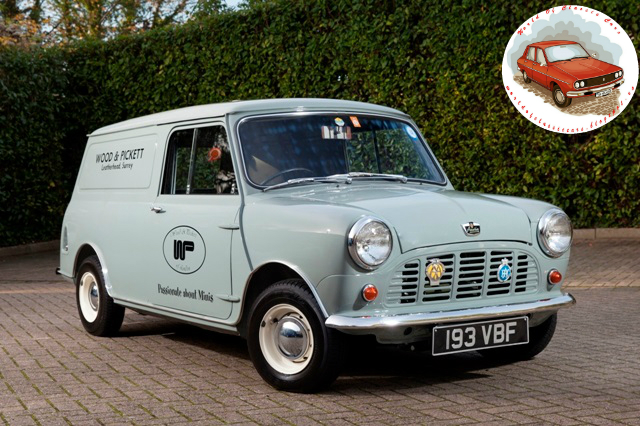
Austin Mini Van 1963 - World Of Classic Cars

Austin Mini Van 1963

The potential for a commercial version of the Mini was an obvious route once it was realised that the distance between the front and rear sub-frames could be changed easily.  The wheelbase was increased by 4" thus increasing the overall length by 10" and making its 46cu. ft. more useable than its sibling, the A35 van, also produced at the Longbridge plant.
The Mini Van was originally offered at a price of £360 excluding purchase tax which did not apply to commercial vehicles. To qualify in the 1960's, the Mini van could only be driven at 30mph, except on the new M1 where it was allowed to do 40mph.

Austin Mini 1000 1979 - World Of Classic Cars -

Austin Mini 1000 1979

The Mini was made by the British Motor Corporation (BMC) and its successors from 1959 until 2000. The original is considered a British icon of the 1960s; with its space-saving, front-wheel drive layout, allowing 80% of the car's floorpan to be used for passengers and luggage. This influenced a generation of car makers and, in 1999, the Mini was voted the second most influential car of the 20th century (behind the Ford Model T). This distinctive, two-door car was designed by Sir Alec Issigonis and was manufactured at the Longbridge and Cowley plants; the very first example, with the now iconic registration plate '621 AOK', is on display at the Heritage Motor Centre in Warwickshire.

duminică, 17 ianuarie 2016

Morris Mini Minor Saloon 1962 - World Of Classic Cars -

Morris Mini Minor Saloon 1962

Perhaps the most instantly recognisable small car in the World, the Mini, was manufactured by the British Motor Corporation (BMC) and its successors at their Longbridge and Cowley plants from 1959 until 2000. The original is considered to be a British icon of the 1960s. Its space-saving front-wheel drive layout, allowing 80% of the area of the car's floorpan to be used for passengers and luggage, influenced a generation of car makers. The vehicle is, in some ways, considered to be the British equivalent of its German contemporary the Volkswagen Beetle, or the Italian Fiat 500. In 1999 the Mini was voted the second most influential car of the 20th century, behind the Ford Model T.
Morris Mini Minor Saloon 1962

Austin Mini 850 Van 1973 - World Of Classic Cars -

Austin Mini 850 Van 1973

The original Mini had three major UK updates, the Mark II, the Clubman and the Mark III. Within the range there were a number of variations, including a Traveller estate, a pick-up truck, a van and the Mini Moke. From 1960 to 1982, a commercial (Quarter Ton) panel van was offered and was built on the longer Traveller chassis but without the side windows. It proved popular in 1960's Britain as a cheaper alternative to the car as it was classed as a commercial vehicle and, as such, carried no sales tax.
Austin Mini 850 Van 1973

A set of simple stamped steel slots served in place of a more costly chrome grille. The Mini Van was utilized by small businesses, delivery drivers, the Police and the AA alike. It was hugely adaptable, reliable and, of course, distinctive.


Austin Mini 850 Van 1973

miercuri, 6 ianuarie 2016

Austin Mini Cooper MK I 1962 - World Of Classic Cars -

Austin Mini Cooper MK I 1962

Designed as project ADO15 (Austin Drawing Office project number 15), the Mini came about because of the fuel shortage caused by the 1956 Suez Crisis. Petrol was once again rationed in the UK, sales of large cars slumped but the market for German 'bubble' cars boomed. Leonard Lord, the somewhat autocratic head of BMC, reportedly detested these cars so much that he vowed to rid the streets of them and design a 'proper miniature car'.
Austin Mini Cooper MK I 1962

Alec Issigonis, had been working for Alvis, but had now been recruited back to BMC in 1955. So with his skills in designing small cars he was a natural for the task. The team that designed the Mini was remarkably small: along with Alec Issigonis, there was Jack Daniels (who had worked with him on the Morris Minor), Chris Kingham (who had been with him at Alvis), two engineering students and four draughtsmen. Together, by October 1957, they had designed and built the original prototype, which was affectionately named "The Orange Box" because of its colour.
Austin Mini Cooper MK I 1962

Issigonis' friend John Cooper, owner of the Cooper Car Company and designer and builder of various Formula One and rally cars, quickly saw the potential of the Mini for competition use. However Issigonis was initially reluctant to see the Mini in the role of a performance car, but after John Cooper appealed to BMC management, the two men collaborated to create the Mini Cooper. It was a nimble, economical and inexpensive car. The Austin Mini Cooper and Morris Mini Cooper debuted in 1961.

joi, 19 iunie 2014

Austin Mini BAC M-30 1989 - World Of Classic Cars -

Austin Mini BAC M-30 1989

In celebration of the Mini’s 30th anniversary in 1989, one speciality aftermarket supplier, the British Automotive Co., decided to pull out all the stops and create the ultimate Mini. The result was the M-30. 
The example presented here, finished in Dark Green Metallic Pearl was treated to the full M-30 body conversion, which included prominent wheel arches and a modified front bumper. The exterior colour was co-ordinated with the lamp bezels, door handles and grille surround, eliminating all the exterior brightwork with the exception of the large hallmarked M-30 solid silver badge and the rims of the 6x13 alloy wheels.
The front seats are by Recaro and feature electric adjustment and heating. The car has BAC’s own instrument binnacle, crash pad and centre console, as well as VDO 8 dial instrumentation, warning lights, and switches. Adding a touch of class, burl elm was used extensively, whilst power windows, an Alpine stereo system, and remote keyless entry with alarm controls finish off the option list of this beautifully appointed Mini.
Austin Mini BAC M-30 1989

The M-30 was originally fitted with a 1.3-litre supercharged engine, which was relatively recently replaced by a 1,380cc engine built by Ian Hargreaves from Avon Baugh Mini Tuners. Accordingly, a performance clutch, a stainless steel exhaust system, and a suspension system featuring adjustable height and damping, provide the driving experience one would expect of such a sporty looking Mini. 
The overall condition and history of the M-30 suggests that it has been driven more than the 457 kilometres indicated on the odometer and although the body fit is not perfect, the paint finish remains impressive. The interior shows some signs of use and the finish on the burled wood exhibits signs of shrinkage/ageing.
Although BAC originally planned to build 30 examples of the M-30, the £30,000 price tag (six times the price of a basic Mini) deterred customers and only three examples were built. Each M-30 had the production number stamped into the handmade silver badge, and this one reads P2, indicating that it was the second example built. A fantastically rare little beast, this M-30 can swivel heads like any contemporary super car.